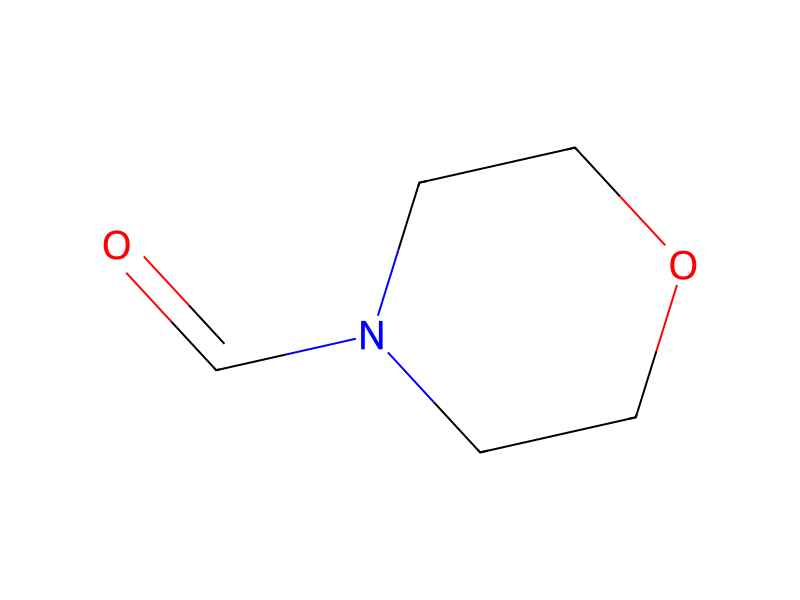
N-Formylmorpholine → 4-(Phenoxymethyl)benzaldehyde
Reaction equation

Br[C:2]1[CH:7]=[CH:6][C:5]([CH2:8][O:9][C:10]2[CH:15]=[CH:14][CH:13]=[CH:12][CH:11]=2)=[CH:4][CH:3]=1.C([Li])CCC.[CH:21](N1CCOCC1)=[O:22]>O1CCCC1>[O:9]([CH2:8][C:5]1[CH:6]=[CH:7][C:2]([CH:21]=[O:22])=[CH:3][CH:4]=1)[C:10]1[CH:15]=[CH:14][CH:13]=[CH:12][CH:11]=1Participants
Reactant 3


Product 1

Reagents, catalysts & solvents 1

Conditions
- Temperature
- 78 °C
Procedure
To a tetrahydrofuran solution (50 mL) of 1-bromo-4-phenoxymethyl-benzene (4.69 g, 17.8 mmol) described in Manufacturing Example 86-1-1 was added dropwise n-butyl lithium (16.8 mL, 1.59 M hexane solution, 26.7 mmol) at −78° C. After 40 minutes of stirring at 78° C., N-formylmorpholine (2.25 g, 19.6 mmol) was added to this mixture, which was then stirred for a further 30 minutes at that temperature. This mixture was partitioned into diethyl ether and water. The organic layer was separated, washed with saturated aqueous sodium chloride, dried over anhydrous magnesium sulfate, and filtered. The filtrate was concentrated under a reduced pressure to obtain the title compound (3.8 g). This compound was used in the subsequent reaction without purification.
Workup
- stirringwas then stirred for a further 30 minutes at that temperature
- customThis mixture was partitioned into diethyl ether and water
- customThe organic layer was separated
- washwashed with saturated aqueous sodium chloride
- dry with materialdried over anhydrous magnesium sulfate
- filtrationfiltered
- concentrationThe filtrate was concentrated under a reduced pressure
Sources & evidence
- ORD record
- ord-50e2690a069049d3bffc5ec37b2e0f4e
- Source dataset
- uspto-grants-2012_04
- Patent number
- US08158657B2
Reaction notes
Loading…