Lithium Hexamethyldisilazide → HCID 87333184, compound
Reaction equation

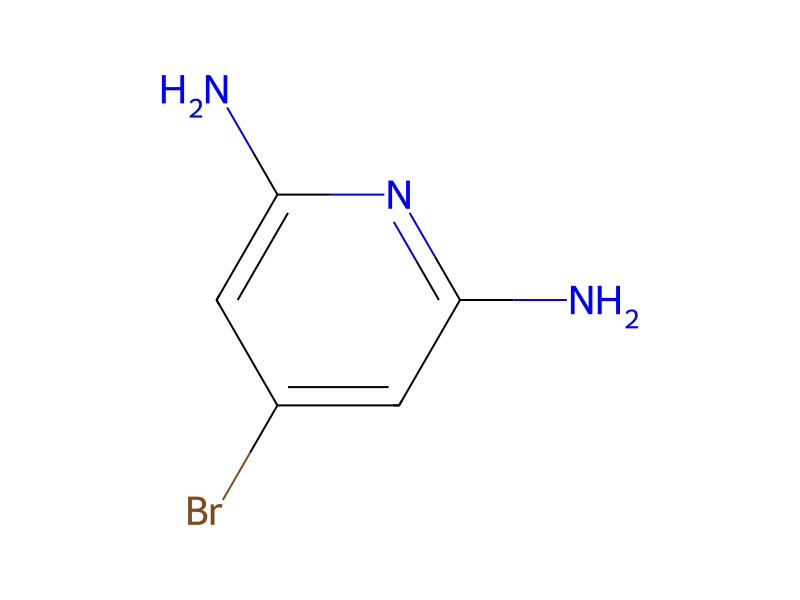
[Br:1][C:2]1[CH:7]=[C:6]([NH2:8])[N:5]=[C:4]([NH2:9])[CH:3]=1.[Li+].C[Si]([N-][Si](C)(C)C)(C)C.[F:20][CH:21]([F:31])[CH2:22]OS(C(F)(F)F)(=O)=O>C1COCC1>[Br:1][C:2]1[CH:7]=[C:6]([NH2:8])[N:5]=[C:4]([NH:9][CH2:22][CH:21]([F:31])[F:20])[CH:3]=1Participants




Conditions
- Temperature
- 0 °C
Procedure
4-Bromo-pyridine-2,6-diamine (2.2 g) was dissolved under an argon atmosphere in THF (15 mL) and cooled to 0° C. At this temperature LiHMDS (12.9 mL 1 M solution in THF) was added slowly to the solution. The reaction mixture was stirred at 0° C. for 1 h. After that difluorethyltriflate (2.76 g) was added and the reaction mixture was stirred at 25° C. for 18 h. Complete conversion was observed by LC-MS analysis. The reaction mixture was evaporated to dryness, dissolved in ethyl acetate and extracted with water and brine. The organic layer was dried over Na2SO4, filtrated and evaporated to dryness. The crude product was purified by flash chromatography over silica gel (70 g SiO2, gradient ethyl acetate/n-heptane 1:4->1:0) to yield 4-bromo-N-(2,2-difluoroethyl)-pyridine-2,6-diamine (0.943 g; 32%) as a dark red oil.
Workup
- stirringthe reaction mixture was stirred at 25° C. for 18 h
- customThe reaction mixture was evaporated to dryness
- dissolutiondissolved in ethyl acetate
- extractionextracted with water and brine
- dry with materialThe organic layer was dried over Na2SO4
- filtrationfiltrated
- customevaporated to dryness
- customThe crude product was purified by flash chromatography over silica gel (70 g SiO2, gradient ethyl acetate/n-heptane 1:4->1:0)
Sources & evidence
- ORD record
- ord-8ef9ddf9c9ed472e8bb06479073ff38d
- Source dataset
- uspto-grants-2012_04
- Patent number
- US08163778B2
Reaction notes
Loading…