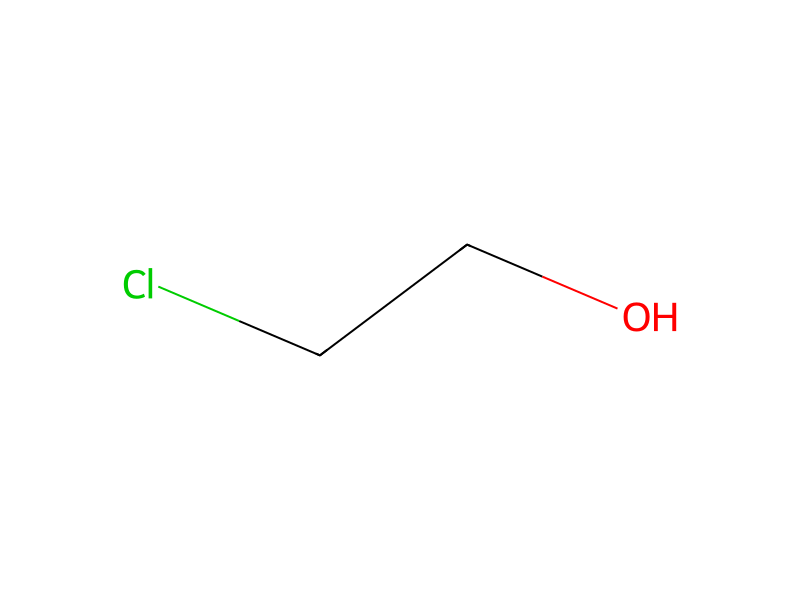
2-Chloroethanol → 2-(4-Bromo-phenyl)-[1,3]dioxolane-2-carboxylic Acid Ethyl Ester
Reaction equation

[CH2:1]([O:3][C:4]([C:6](=[O:14])[C:7]1[CH:12]=[CH:11][C:10]([Br:13])=[CH:9][CH:8]=1)=[O:5])[CH3:2].Cl[CH2:16][CH2:17][OH:18].O1CCCC1.C(O)(C)(C)C.[K]>CN(C)C=O>[CH2:1]([O:3][C:4]([C:6]1([C:7]2[CH:8]=[CH:9][C:10]([Br:13])=[CH:11][CH:12]=2)[O:18][CH2:17][CH2:16][O:14]1)=[O:5])[CH3:2]Participants
Reactant 4



Product 1

Reagents, catalysts & solvents 1

Conditions
- Temperature
- -60 °C
Procedure
To a solution of ethyl-4-bromobenzoylformate (940 mg) and 2-chloroethanol (0.360 mL) in a 2:1 mixture of dimethylformamide:tetrahydrofuran (2.1 mL) was added dropwise at −60° C. a solution of potassium tert-butanol (0.597 mg) in dimethylformamide (2 mL). The reaction mixture was stirred at −60° C. for 4 h then allowed to warm up to room temperature and stirred at room temperature overnight. The reaction mixture was partitioned between an aqueous solution of ammonium chloride and ethyl acetate. The aqueous layer was extracted with ethyl acetate and the combined organic layer were washed with brine. The crude mixture was concentrated to dryness and purified by chromatography on silica gel to yield the title compound as a colorless liquid (616 mg; 58%). MS (ESI): m/z=300.8 [M+H]+.
Workup
- temperatureto warm up to room temperature
- stirringstirred at room temperature overnight
- customThe reaction mixture was partitioned between an aqueous solution of ammonium chloride and ethyl acetate
- extractionThe aqueous layer was extracted with ethyl acetate
- washthe combined organic layer were washed with brine
- concentrationThe crude mixture was concentrated to dryness
- custompurified by chromatography on silica gel
Sources & evidence
- ORD record
- ord-7fb622fe119b449c9486b2338dee5d13
- Source dataset
- uspto-grants-2012_04
- Patent number
- US08163793B2
Reaction notes
Loading…