Styrene Oxide → HCID 67266647, compound
Reaction equation

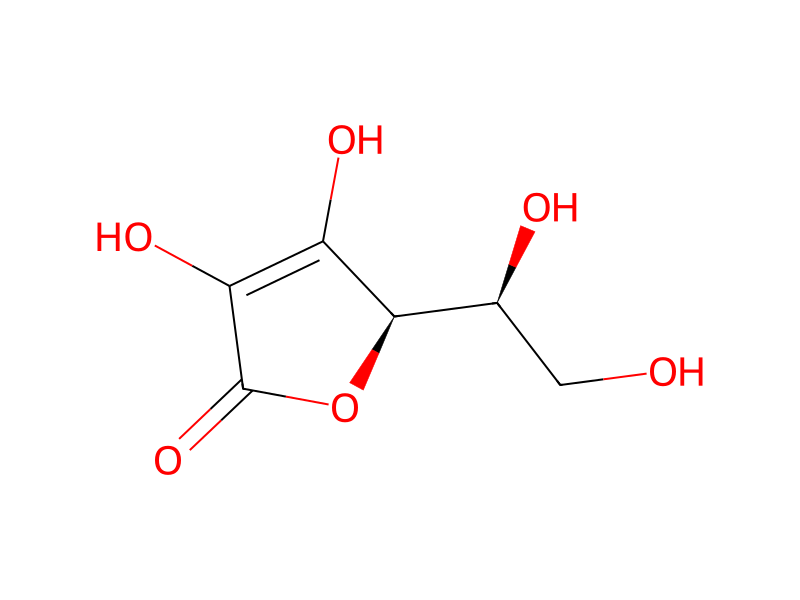
C(O)(C(F)(F)F)C(F)(F)F.[O:11]=[C:12]1[O:18][C@H:17]([C@H:19]([CH2:21][OH:22])[OH:20])[C:15]([OH:16])=[C:13]1[OH:14].[CH2:23]1[O:31][CH:24]1[C:25]1[CH:30]=[CH:29][CH:28]=[CH:27][CH:26]=1>C(#N)C>[OH:31][CH2:23][CH:24]([O:16][C:15]1[C@@H:17]([C@H:19]([CH2:21][OH:22])[OH:20])[O:18][C:12](=[O:11])[C:13]=1[OH:14])[C:25]1[CH:30]=[CH:29][CH:28]=[CH:27][CH:26]=1Participants
Reactant 3


Product 1

Reagents, catalysts & solvents 1

Conditions
- Temperature
- 70 °C
Procedure
Under an argon atmosphere, 4 ml of 1,1,1,3,3,3-hexafluoro isopropanol and 10 ml of acetonitrile were added to L-ascorbic acid (1.00 g), and further, styrene oxide (1.37 g) was added. The mixture was heated up to 70° C. and stirred for 48 hours, then, concentrated under reduced pressure, and 2.73 g of the resultant residue was subjected to silica gel column chromatography. Thereafter, it was eluted with chloroform/methanol/water(volume ratio:20/3/0.3) to obtain two elution fractions (first eluted fraction: 225 mg, later eluted fraction: 228 mg). Based on the measurement results of high resolution mass analysis, infrared absorption spectrum, 1H-NMR, 13C-NMR and specific optical rotation on the resultant elution fractions, it was confirmed that these are two 3-O-(2-hydroxy-1-phenylethyl) ascorbic acids which are in mutual stereoisomerism and both of them are represented by the following structural formula.
Workup
- concentrationconcentrated under reduced pressure, and 2.73 g of the resultant residue
- washThereafter, it was eluted with chloroform/methanol/water(volume ratio:20/3/0.3)
- customto obtain
- washtwo elution fractions (first eluted fraction
- customresults of high resolution mass analysis
- customabsorption spectrum
- wash1H-NMR, 13C-NMR and specific optical rotation on the resultant elution fractions, it
Sources & evidence
- ORD record
- ord-7a25156f7ac949b99cb70cbe7cb831a6
- Source dataset
- uspto-grants-2012_04
- Patent number
- US08163939B2
Reaction notes
Loading…