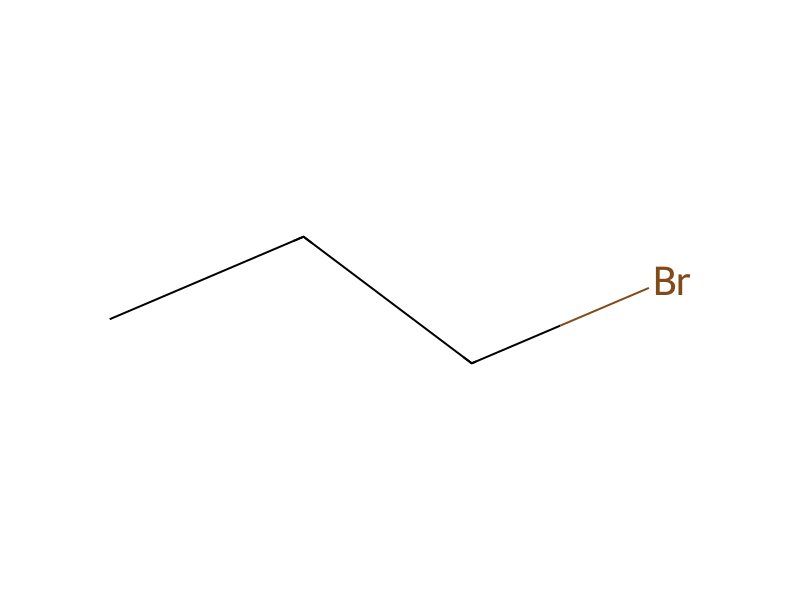
1-Bromopropane → 1-Propylindole-3-carboxylic acid methyl ester
Reaction equation

[CH3:1][O:2][C:3]([C:5]1[C:13]2[C:8](=[CH:9][CH:10]=[CH:11][CH:12]=2)[NH:7][CH:6]=1)=[O:4].C([O-])([O-])=O.[K+].[K+].Br[CH2:21][CH2:22][CH3:23]>CN(C=O)C>[CH3:1][O:2][C:3]([C:5]1[C:13]2[C:8](=[CH:9][CH:10]=[CH:11][CH:12]=2)[N:7]([CH2:21][CH2:22][CH3:23])[CH:6]=1)=[O:4]Participants
5
Reactant 3


Product 1

Reagents, catalysts & solvents 1

Procedure
A solution of 0.16 g (1.00 mmol) of indole-3-carboxylic acid methyl ester, 0.5 g (4 mmol) of K2CO3 and 0.5 g (5 mmol) of 1-bromopropane in 10 ml of DMF was stirred at 50° C. overnight. The mixture was partitioned between EtOAc and water. The aqueous phase was extracted with additional EtOAc. The combined organic phases were washed with water, brine and finally dried over Na2SO4 to give crude 1-propylindole-3-carboxylic acid methyl ester.
Workup
- customThe mixture was partitioned between EtOAc and water
- extractionThe aqueous phase was extracted with additional EtOAc
- washThe combined organic phases were washed with water, brine
- dry with materialfinally dried over Na2SO4
Sources & evidence
- ORD record
- ord-1ae24cb9a40d46a8a7ca9df0b437576b
- Source dataset
- uspto-grants-2002_02
- Patent number
- US06346625B1
Reaction notes
Loading…