Hydrochloric Acid → 4-acetyl-4'-chlorobiphenyl
Reaction equation

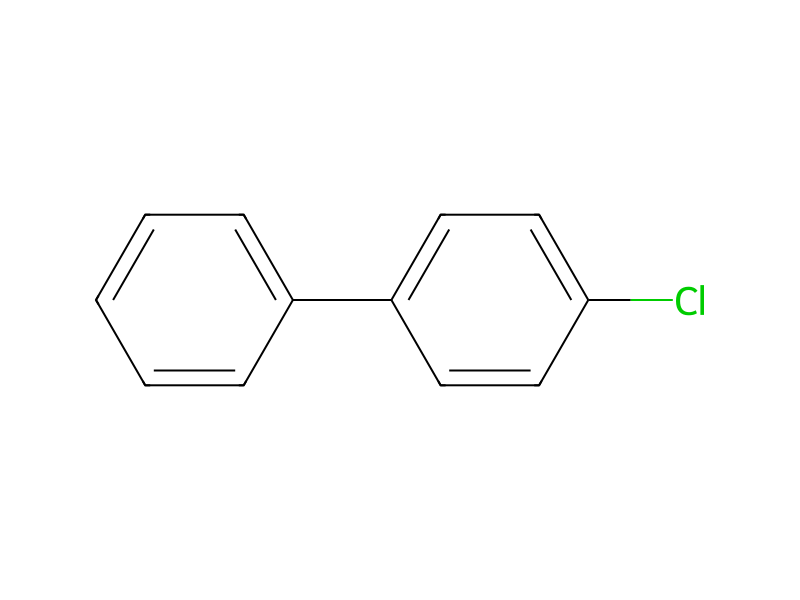
[Cl-].[Al+3].[Cl-].[Cl-].[Cl:5][C:6]1[CH:11]=[CH:10][C:9]([C:12]2[CH:17]=[CH:16][CH:15]=[CH:14][CH:13]=2)=[CH:8][CH:7]=1.[C:18](Cl)(=[O:20])[CH3:19].Cl>O.C(Cl)Cl.C(Cl)(Cl)(Cl)Cl>[Cl:5][C:6]1[CH:7]=[CH:8][C:9]([C:12]2[CH:17]=[CH:16][C:15]([C:18](=[O:20])[CH3:19])=[CH:14][CH:13]=2)=[CH:10][CH:11]=1Participants
8







Procedure
To a cooled, stirred suspension containing 154 gms. of anhydrous aluminum chloride, 800 ml. of carbon tetrachloride and 200 gms of p-chlorobiphenyl add (dropwise) 91 gms of acetyl chloride. When the reaction temperature of the mixture reaches 10° C., add 60 ml of methylene chloride and allow the reaction mixture to slowly reach room temperature. Stir the mixture overnight. Pour the resulting mixture into 1 liter of crushed ice and water containing 100 ml. of conc. hydrochloric acid. Separate the organic phase, dry over anhydrous sulfate, filter, concentrate, and triturate the solid residue with 600 ml. of hexane to yield 1-(4'chloro[1,1']biphenyl-4-yl) ethanone, m.p. 100°-101° C.
Workup
- additioncontaining 154 gms
- customreaches 10° C.
- customto slowly reach room temperature
- stirringStir the mixture overnight
- customSeparate the organic phase
- dry with materialdry over anhydrous sulfate
- filtrationfilter
- concentrationconcentrate
- customtriturate the solid residue with 600 ml
Sources & evidence
- ORD record
- ord-4255119f6bc64bc48804a11220723827
- Source dataset
- uspto-grants-1978_11
- Patent number
- US04125612
Reaction notes
Loading…