Ammonia → HCID 20337233, compound
Reaction equation

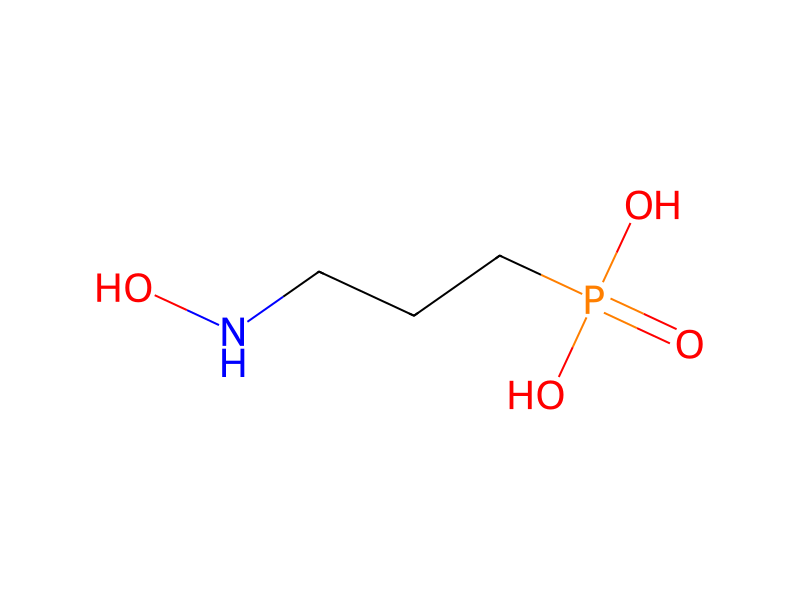
[F:1][C:2]([F:7])([F:6])[C:3](O)=[O:4].[OH:8][NH:9][CH2:10][CH2:11][CH2:12][P:13](=[O:16])([OH:15])[OH:14].FC(F)(F)C(OC(=O)C(F)(F)F)=O.N>C(O)C.O>[OH:8][N:9]([CH2:10][CH2:11][CH2:12][P:13](=[O:14])([OH:16])[OH:15])[C:3](=[O:4])[C:2]([F:7])([F:6])[F:1]Participants





Procedure
Trifluoroacetic acid (4 ml) was added to 3-(N-hydroxyamino)propylphosphonic acid (1.55 g). After the mixture was stirred at ambient temperature for 15 minutes, to the mixture was added trifluoroacetic anhydride (2.52 g) with stirring under ice-cooling. After the stirring was continued at the same temperature for 1.5 hours, to the mixture was further added trifluoroacetic anhydride (2.73 g). The mixture was further stirred for an hour. Then, the resultant mixture was concentrated under reduced pressure to give a residue, which was dissolved in ethanol (10 ml). The solution was adjusted to pH 6-7 with aqueous ammonia, stirred for an hour under ice-cooling and concentrated under reduced pressure to give a residue, which was subjected to a column chromatography on cellulose (100 ml). This column was washed with isopropylalcohol (200 ml) and then the object compound was eluted with a mixture of isopropyl alcohol and water (9:1 ) (200 ml). The eluate was concentrated under reduced pressure to give a residue, which was pulverized with a mixture of ethanol and water to give powdery monoammonium salt of 3-(N-hydroxy-N-trifluoroacetylamino)propylphosphonic acid (0.2 g).
Workup
- stirringwith stirring under ice-
- temperaturecooling
- waitAfter the stirring was continued at the same temperature for 1.5 hours, to the mixture
- stirringThe mixture was further stirred for an hour
- concentrationThen, the resultant mixture was concentrated under reduced pressure
- customto give a residue, which
- stirringstirred for an hour under ice-
- temperaturecooling
- concentrationconcentrated under reduced pressure
- customto give a residue, which
- washThis column was washed with isopropylalcohol (200 ml)
- washthe object compound was eluted with a mixture of isopropyl alcohol and water (9:1 ) (200 ml)
- concentrationThe eluate was concentrated under reduced pressure
- customto give a residue, which
Sources & evidence
- ORD record
- ord-fe315a03af054273b9ba0f8bfcef0e24
- Source dataset
- uspto-grants-1980_06
- Patent number
- US04206156
Reaction notes
Loading…