2,6-Dichloro-4-nitroaniline → HCID 23036551, compound
Reaction equation

C([O-])(=O)C.[Na+].[Cl:6][C:7]1[CH:13]=[C:12]([N+:14]([O-:16])=[O:15])[CH:11]=[C:10]([Cl:17])[C:8]=1[NH2:9].CO[CH:20]1[CH:28]2[CH:23]([CH2:24][CH2:25][CH2:26][CH2:27]2)[CH:22](OC)O1.C(OCC)(=O)C>C(O)(=O)C.O>[Cl:6][C:7]1[CH:13]=[C:12]([N+:14]([O-:16])=[O:15])[CH:11]=[C:10]([Cl:17])[C:8]=1[N:9]1[CH:20]=[C:28]2[C:23]([CH2:24][CH2:25][CH2:26][CH2:27]2)=[CH:22]1Participants
Reactant 4
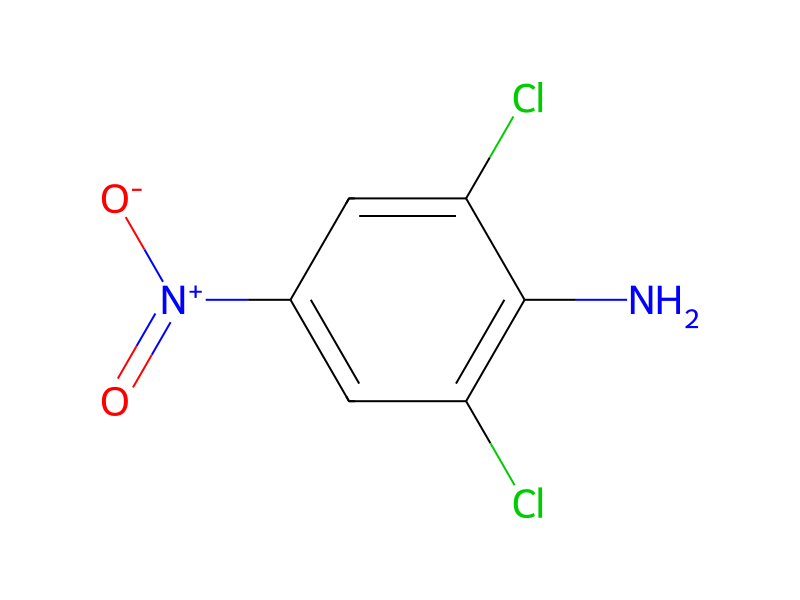



Product 1

Reagents, catalysts & solvents 2


Procedure
To a mixture of sodium acetate (14.0 g) in 225 ml of acetic acid heated to refluxing is first added 2,6-dichloro-4-nitroaniline (6.40 g, 30.8 mmol), followed by 1,3-dimethoxyoctahydroisobenzofuran (5.73 g, 30.8 mmol). The reaction mixture is heated under reflux for 16 hours, after which the acetic acid is stripped off by rotoevaporation and the residue is poured into ethyl acetate and water. The aqueous layer is extracted with ethyl acetate, and the combined organic layers are washed with water and with brine and dried. The residue is purified by column chromatography to give 2-(2,6-dichloro-4-nitrophenyl)-4,5,6,7-tetrahydroisoindole, which is then reduced with stannous chloride according to Example 9 procedures to give 3,5-dichloro-4-(4,5,6,7-tetrahydroisoindol-2-yl)aniline.
Workup
- temperatureheated
- temperatureto refluxing
- temperatureThe reaction mixture is heated
- temperatureunder reflux for 16 hours
- extractionThe aqueous layer is extracted with ethyl acetate
- washthe combined organic layers are washed with water and with brine
- customdried
- customThe residue is purified by column chromatography
Sources & evidence
- ORD record
- ord-a0a1aca5e0c841769d8764f0ec11a1c7
- Source dataset
- uspto-grants-1990_08
- Patent number
- US04950678
Reaction notes
Loading…