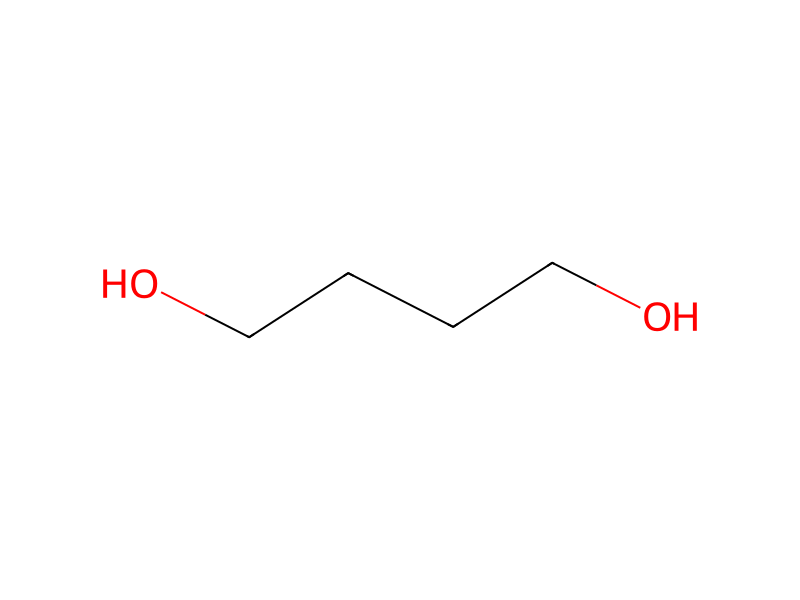
1,4-Butanediol → HCID 53643992, compound
Reaction equation

[CH2:1]([OH:6])[CH2:2][CH2:3][CH2:4][OH:5].[CH:7]([S:13](Cl)(=[O:15])=[O:14])([S:9](Cl)(=[O:11])=[O:10])[CH3:8].C(N(CC)CC)C.[Cl-].[Cl-].[Ca+2]>C(COC)OC>[CH:7]1([S:13](=[O:15])(=[O:14])[O:6][CH2:1][CH2:2][CH2:3][CH2:4][O:5][S:9]1(=[O:11])=[O:10])[CH3:8]Participants
Reactant 4



Product 1

Reagents, catalysts & solvents 1

Procedure
1,4-Butanediol, obtained from Aldrich Chemical Co. (3.6 g, 0.04 mole) was dissolved in 75 ml of glyme in a 1 liter round bottom flask. A solution of 1,1-ethanedisulfonyl chloride (9.1 g, 0.04 mole) dissolved in 25 ml of glyme wa added to the flask through a dropping funnel. The reaction mixture was kept below -20° C. with a dowanol-dry ice bath. Triethylamine (8.08 g, 0.08 mole) dissolved in 100 ml of glyme was added to the mixture through a 125 ml dropping funnel over a period of 1 hour. Care was taken to maintain anhydrous conditions by covering the dropping funnels with drying tubes containing CaCl2. The reaction mixture was brought to 25° C. in a cold water bath. The glyme was removed by roto-evaporation, at a temperature below 37° C. The oily yellow residue that remained after removal of the glyme was washed once with 100 ml of 5% sodium bicarbonate and once with 50 ml of cold distilled water, the resulting emulsion being centrifuged immediately to separate the product, and aqueous material decanted. The remaining precipitate was dried under vacuum. The white, powdery solid which remained weighed 0.90 g, representing a 9.2% yield. Product identification was confirmed by characteristic IR and proton NMR spectral features. The product decomposed between 115 and 138° C. The product was soluble to less than about 0.01 gram in 1 ml of either methylene chloride or acetonitrile.
Workup
- additionwa added to the flask through a dropping funnel
- customThe reaction mixture was kept below -20° C. with a dowanol-dry ice bath
- additionwas added to the mixture through a 125 ml
- customof 1 hour
- temperatureto maintain anhydrous conditions
- customThe reaction mixture was brought to 25° C. in a cold water bath
- customThe glyme was removed by roto-evaporation, at a temperature below 37° C
- customafter removal of the glyme
- washwas washed once with 100 ml of 5% sodium bicarbonate and once with 50 ml
- distillationof cold distilled water
- customto separate the product, and aqueous material
- customdecanted
- customThe remaining precipitate was dried under vacuum
- customdecomposed between 115 and 138° C
Sources & evidence
- ORD record
- ord-b8548ffa984b434baf74a50e065ef1ce
- Source dataset
- uspto-grants-1990_08
- Patent number
- US04950768
Reaction notes
Loading…