Phenol → Phloroglucinol
Reaction equation

[C:1]1([CH:8]=[CH:7][CH:6]=[C:4]([OH:5])[CH:3]=1)[OH:2].C1([OH:15])C=CC=CC=1>O>[C:1]1([OH:2])[CH:8]=[CH:7][CH:6]=[CH:4][CH:3]=1.[CH:8]1[C:1]([OH:2])=[CH:3][C:4]([OH:5])=[CH:6][C:7]=1[OH:15]Participants
Reactant 2

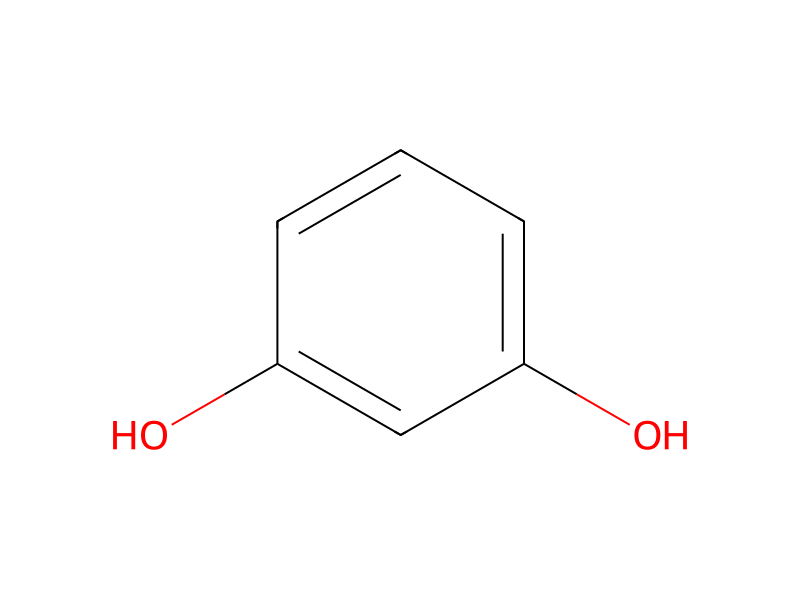
Product 2
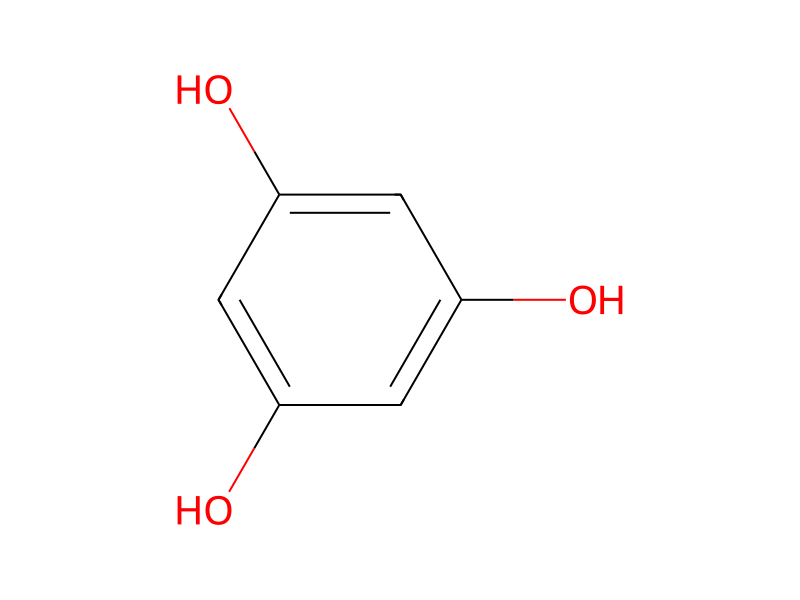
Reagents, catalysts & solvents 1

Procedure
60 cc of distilled water was added to 0.70 g of natural montmorillonite (as the clay; Kunipia P, made by Kunimine Industries), and this was put into a sealed plastic vessel along with a Teflon® agitator and shaken vigorously, which gave a uniform dispersion. To this dispersion was added 0.30 g of resorcinol powder (as a polyhydric phenol; made by Wako Pure Chemical Industries), and this dispersion was poured into a flat-bottomed brass tray that had a circular bottom measuring about 15 cm in diameter, and the dispersion was allowed to stand horizontally so that the clay particles would gradually settle. With the tray held horizontal, the dispersion was dried for 5 hours at a temperature of 50° C. in a forced air oven, which gave a uniform polyhydric phenol composite clay thin film (phloroglucin Kunipia P thin film) with a thickness of approximately 30 μm. The clay thin film thus produced was dried in an oven held at 110° C. This gave a clay thin film that could be easily peeled from the tray.
Workup
- customwhich gave a uniform dispersion
- customthe dispersion was dried for 5 hours at a temperature of 50° C. in a forced air oven
Sources & evidence
- ORD record
- ord-edf71d57b3c54a55946dec61583fd0af
- Source dataset
- uspto-grants-2010_09
- Patent number
- US07799395B2
Reaction notes
Loading…