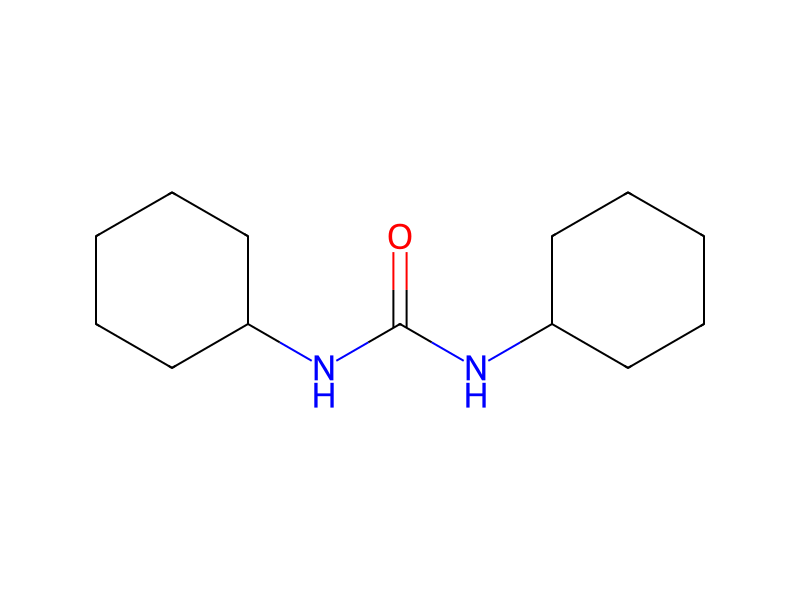
Dicyclohexylcarbodiimide → N,N'-Dicyclohexylurea
Reaction equation

CC1CC(C)CN(C2N=CC=CC=2C(O)=[O:12])C1.ON1C2C=CC=CC=2N=N1.Cl.C(OC(=O)C1C=CC(CCN)=CC=1OC)C.[CH:45]1([N:51]=[C:52]=[N:53][CH:54]2[CH2:59][CH2:58][CH2:57][CH2:56][CH2:55]2)[CH2:50][CH2:49][CH2:48][CH2:47][CH2:46]1>CN(C)C=O.C(N(CC)CC)C>[C:52]([NH:51][CH:45]1[CH2:46][CH2:47][CH2:48][CH2:49][CH2:50]1)([NH:53][CH:54]1[CH2:59][CH2:58][CH2:57][CH2:56][CH2:55]1)=[O:12]Participants
Reactant 4




Product 1
Reagents, catalysts & solvents 2


Conditions
- Temperature
- 50 °C
Procedure
5.85 g of 2-(3,5-dimethylpiperidino)-nicotinic acid (prepared from 2-chloronicotinic acid and 3,5-dimethylpiperidine) were dissolved in 25 ml of dimethylformamide. After the addition of 10.41 g of 1-hydroxybenzotriazole (32.4%), 6.5 g of 4-(2-aminoethyl)-2-methoxybenzoic acid ethyl ester . hydrochloride, 6.92 ml of triethylamine and 6.18 g of dicyclohexylcarbodiimide the mixture was stirred for 30 minutes at 50° C. and left to stand overnight at room temperature. Dicyclohexylurea obtained was suction-filtered and washed with 25 ml of dimethylformamide. The combined filtrates were poured into 250 ml of ice-water. Extraction three times with 100 ml of ethyl acetate each time, washing of the acetic ester phase with sodium dicarbonate solution and water and concentration in vacuo gave the ethyl 4-(2-<2-(3,5-dimethylpiperidino)-pyridine-3-carboxamido>ethyl)-2-methoxybenzoate.
Workup
- waitleft
- waitto stand overnight at room temperature
Sources & evidence
- ORD record
- ord-5d7369de09a44e2182a15abba75b640e
- Source dataset
- uspto-grants-1985_09
- Patent number
- US04542127
Reaction notes
Loading…