1,2-Dibromoethane → 1,1-Cyclopropanedicarboxylic acid, 1,1-dimethyl ester
Reaction equation

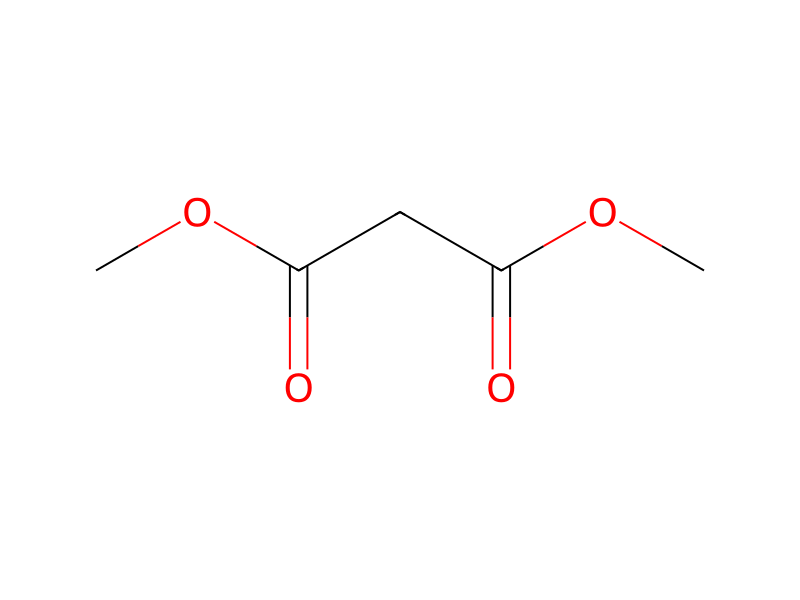
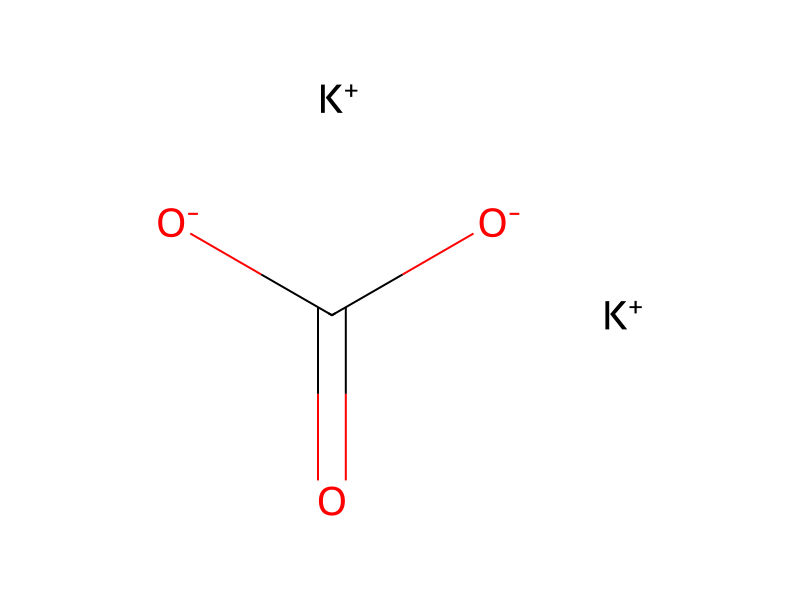
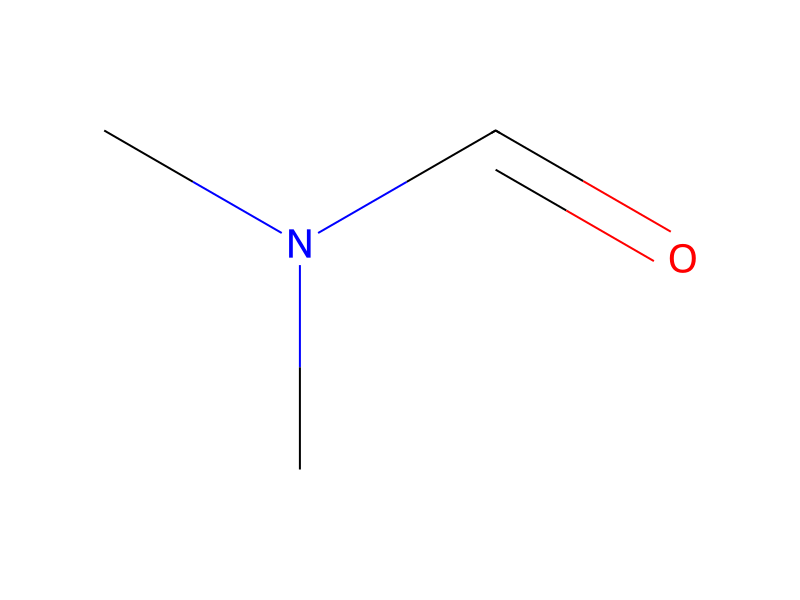
[C:1]([O:8][CH3:9])(=[O:7])[CH2:2][C:3]([O:5][CH3:6])=[O:4].Br[CH2:11][CH2:12]Br.BrC(Br)C.C(=O)([O-])[O-].[K+].[K+]>C(=O)([O-])[O-].[K+].[K+].CN(C)C=O.CN(C)C=O>[C:2]1([C:1]([O:8][CH3:9])=[O:7])([C:3]([O:5][CH3:6])=[O:4])[CH2:12][CH2:11]1Participants
Reactant 4


Product 1

Reagents, catalysts & solvents 2

Procedure
The cycloalkylation of dimethyl malonate with 1,2-dibromoethane in potassium carbonate/dimethylformamide is disclosed by D. A. White in Synthesis Communications 7/8 (1977) 559. Based on 1 mol of dimethyl malonate, 4 mols of dibromoethane and 2.4 mols of potassium carbonate in 1.2 liters of dimethylformamide are reacted for 22 hours, yielding 73% of theory of dimethyl cyclopropane-1,1-dicarboxylate (CDM). These are data of a poor space-time yield which stands in the way of using the method on an industrial scale. A further target must be to replace the 1,2-dibromoethane with 1,2-dichloroethane, for instance. However, dichlorides are not very reactive. The comparative example below shows that 1,2-dichoroethane produces CDM with a yield of 55% of theory, whereas 1,2-dibromoethane produces CDM with a yield of 96.5% of theory. The disposal of potassium chloride by electrolysis is simple, but the disposal of potassium bromide is not. Nonetheless, many attempts have been made to use the dichloride. Thus, J. Heiszman et al, Synthesis Communications 1987, 738, used benzene as a solvent medium and also used a phase transfer catalyst, which yielded diethyl cyclopropane-1,1-dicarboxylate (CDE) in over 20 hours at 80° C. The use of solvents such as benzene is no longer allowed. Phase transfer catalysts are difficult to dispose of and form amines during decomposition.
Workup
- customWhite in Synthesis Communications 7/8 (1977) 559
- customare reacted for 22 hours
Sources & evidence
- ORD record
- ord-9c56f14702cd42839b31910bf2de89e1
- Source dataset
- uspto-grants-1996_04
- Patent number
- US05510509
Reaction notes
Loading…