Pyrrolidine → Z-6-chloro-3-(3,3-dimethyl-butylidene)-1,3-dihydro-indol-2-one
Reaction equation

[Cl:1][C:2]1[CH:10]=[C:9]2[C:5]([CH2:6][C:7](=[O:11])[NH:8]2)=[CH:4][CH:3]=1.[CH3:12][C:13]([CH3:18])([CH3:17])[CH2:14][CH:15]=O.N1CCCC1>CO>[Cl:1][C:2]1[CH:10]=[C:9]2[C:5](/[C:6](=[CH:15]/[CH2:14][C:13]([CH3:18])([CH3:17])[CH3:12])/[C:7](=[O:11])[NH:8]2)=[CH:4][CH:3]=1Participants
5
Reactant 3


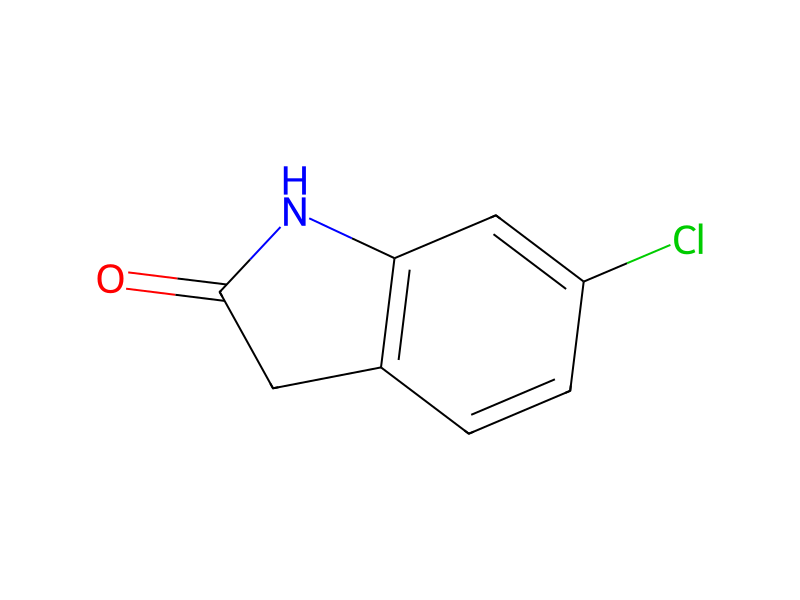
Product 1

Reagents, catalysts & solvents 1

Conditions
- Temperature
- 100 °C
Procedure
To the mixture of 6-chlorooxindole (0.26 g, 1.49 mmol) (Crescent) and 3,3-dimethyl-butyraldehyde (0.21 g, 2.09 mmol) (Aldrich) in methanol (20 mL) was added pyrrolidine (0.15 g, 2.09 mmol) (Aldrich) dropwise. The mixture was then heated at 100° C. for 1 h. The mixture was concentrated, and the residue was partitioned between ethyl acetate and water. The organic layer was separated, dried over Na2SO4, concentrated, and dried in vacuo to give the crude E/Z-6-chloro-3-(3,3-dimethyl-butylidene)-1,3-dihydro-indol-2-one as a white solid (Yield 0.37 g, 100%).
Workup
- concentrationThe mixture was concentrated
- customthe residue was partitioned between ethyl acetate and water
- customThe organic layer was separated
- dry with materialdried over Na2SO4
- concentrationconcentrated
- customdried in vacuo
Sources & evidence
- ORD record
- ord-6f1ccc43c2244600ba1f8144cbf92c43
- Source dataset
- uspto-grants-2009_02
- Patent number
- US07495007B2
Reaction notes
Loading…