Pyrrolidine → 6-Chloro-3-(5-chloro-pyridine-3-ylmethylene)-1,3-dihydro-indol-2-one
Reaction equation

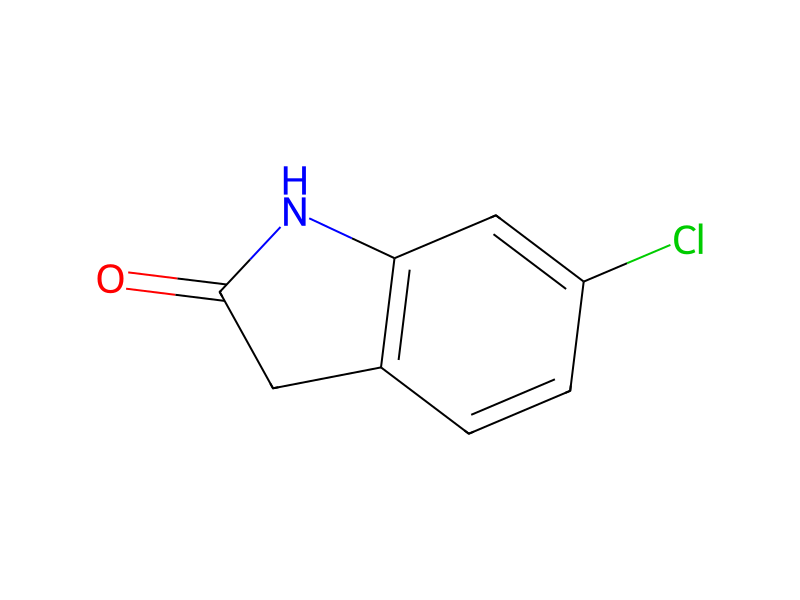
ClC1C=C2C(CC(=O)N2)=CC=1.ClC1C=C(C=O)C=NC=1.N1CCCC1.[Cl:26][C:27]1[CH:35]=[C:34]2[C:30](/[C:31](=[CH:37]/[C:38]3[CH:39]=[N:40][CH:41]=[C:42]([Cl:44])[CH:43]=3)/[C:32](=[O:36])[NH:33]2)=[CH:29][CH:28]=1>CO>[Cl:26][C:27]1[CH:35]=[C:34]2[C:30]([C:31](=[CH:37][C:38]3[CH:39]=[N:40][CH:41]=[C:42]([Cl:44])[CH:43]=3)[C:32](=[O:36])[NH:33]2)=[CH:29][CH:28]=1Participants
6
Reactant 4



Product 1

Reagents, catalysts & solvents 1

Conditions
- Temperature
- 70 °C
Procedure
To the mixture of 6-chlorooxindole (0.93 g, 5.6 mmol) and 5-chloro-pyridine-3-carbaldehyde (0.8 g, 5.6 mmol) in methanol (10 mL) was added pyrrolidine (0.6 g, 5.6 mmol) dropwise. The mixture was then heated at 70° C. for 3 h and cooled to room temperature. The precipitate was collected, dried to give a mixture of E/Z-6-chloro-3-(5-chloro-pyridine-3-ylmethylene)-1,3-dihydro-indol-2-one as a bright yellow solid (Yield 1.0 g, 63%).
Workup
- temperaturecooled to room temperature
- customThe precipitate was collected
- customdried
- customto give
Sources & evidence
- ORD record
- ord-3c636d0d8f7249faae9abea1b1efb620
- Source dataset
- uspto-grants-2009_02
- Patent number
- US07495007B2
Reaction notes
Loading…