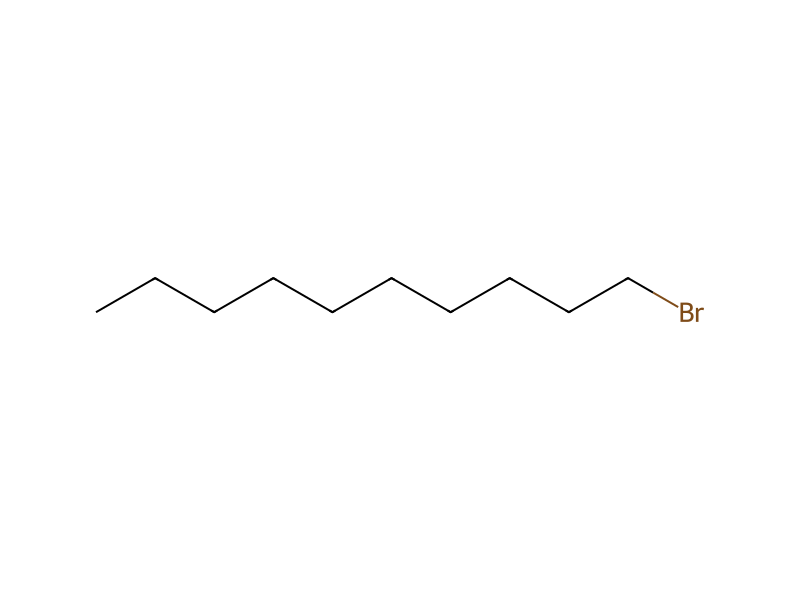
1-Bromodecane → 4-(Decyloxy)-3-(1,1-dimethylethyl)benzoic acid methyl ester
Reaction equation

[CH3:1][O:2][C:3](=[O:15])[C:4]1[CH:9]=[CH:8][C:7]([OH:10])=[C:6]([C:11]([CH3:14])([CH3:13])[CH3:12])[CH:5]=1.Br[CH2:17][CH2:18][CH2:19][CH2:20][CH2:21][CH2:22][CH2:23][CH2:24][CH2:25][CH3:26].C(=O)([O-])[O-].[K+].[K+]>[I-].[K+].CC(=O)CC>[CH3:1][O:2][C:3](=[O:15])[C:4]1[CH:9]=[CH:8][C:7]([O:10][CH2:17][CH2:18][CH2:19][CH2:20][CH2:21][CH2:22][CH2:23][CH2:24][CH2:25][CH3:26])=[C:6]([C:11]([CH3:12])([CH3:14])[CH3:13])[CH:5]=1Participants
6
Reactant 3


Product 1

Reagents, catalysts & solvents 2


Procedure
A mixture of 12.0 g of 3-(1,1-dimethylethyl)-4-hydroxybenzoic acid methyl ester, 11.15 g of 1-bromodecane, 9.95 g of potassium carbonate, 0.797 g of potassium iodide and 100 ml of 2-butanone is heated at reflux temperature for 40 hours. The reaction is cooled, filtered and the filtrate concentrated in vacuo. The residue is purified by chromatography (silica gel: 0-3% ethyl acetate/hexane) to give 18.49 g of the desired product as a light yellow oil.
Workup
- temperatureis heated
- temperatureat reflux temperature for 40 hours
- temperatureThe reaction is cooled
- filtrationfiltered
- concentrationthe filtrate concentrated in vacuo
- customThe residue is purified by chromatography (silica gel: 0-3% ethyl acetate/hexane)
Sources & evidence
- ORD record
- ord-7f11c824057a4b6ea25ba39b9a052d29
- Source dataset
- uspto-grants-1994_07
- Patent number
- US05328921
Reaction notes
Loading…