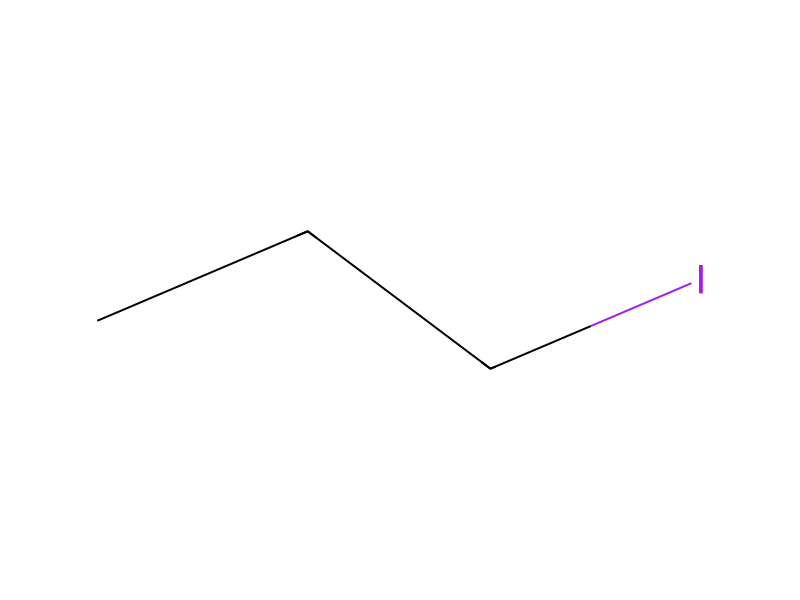
1-Iodopropane → HCID 19016752, compound
Reaction equation

[Na].[SH:2][C:3]1[NH:4][C:5]([C:13]([O:15][CH2:16][CH3:17])=[O:14])=[C:6]([C:8]([O:10][CH2:11][CH3:12])=[O:9])[N:7]=1.[CH2:18](I)[CH2:19][CH3:20]>CO>[CH2:18]([S:2][C:3]1[NH:7][C:6]([C:8]([O:10][CH2:11][CH3:12])=[O:9])=[C:5]([C:13]([O:15][CH2:16][CH3:17])=[O:14])[N:4]=1)[CH2:19][CH3:20]Participants
Reactant 3


Product 1

Reagents, catalysts & solvents 1

Procedure
Sodium (0.253 g, 11 mmol) was dissolved in anhydrous methanol (150 mL) with ice-bath cooling. The ice-bath was removed after all the sodium had reacted and diethyl 2-mercapto-4,5-imidazoledicarboxylate prepared in accord with the second paragraph of Example XI (2.44 g, 10 mmol) was added. The appropriate n-propyl iodide (11 mmol) was added and the reaction mixture was stirred at ambient temperature under a nitrogen atmosphere for 1 hour. A second aliquot of n-propyliodide (3.52 mmol) was added and the solution was stirred for an additional 3 hours. The reaction mixture was concentrated to dryness in vacuo. The residue was partitioned between dichloromethane-water (5:1). The organic layer was separated, dried (sodium sulfate), filtered and concentrated to dryness in vacuo to give the captioned product as an oil.
Workup
- temperaturecooling
- customThe ice-bath was removed after all the sodium
- customhad reacted
- additionwas added
- stirringthe solution was stirred for an additional 3 hours
- concentrationThe reaction mixture was concentrated to dryness in vacuo
- customThe residue was partitioned between dichloromethane-water (5:1)
- customThe organic layer was separated
- dry with materialdried (sodium sulfate)
- filtrationfiltered
- concentrationconcentrated to dryness in vacuo
Sources & evidence
- ORD record
- ord-76970d6672de4700a47aad61e7d3178e
- Source dataset
- uspto-grants-1994_07
- Patent number
- US05329012
Reaction notes
Loading…