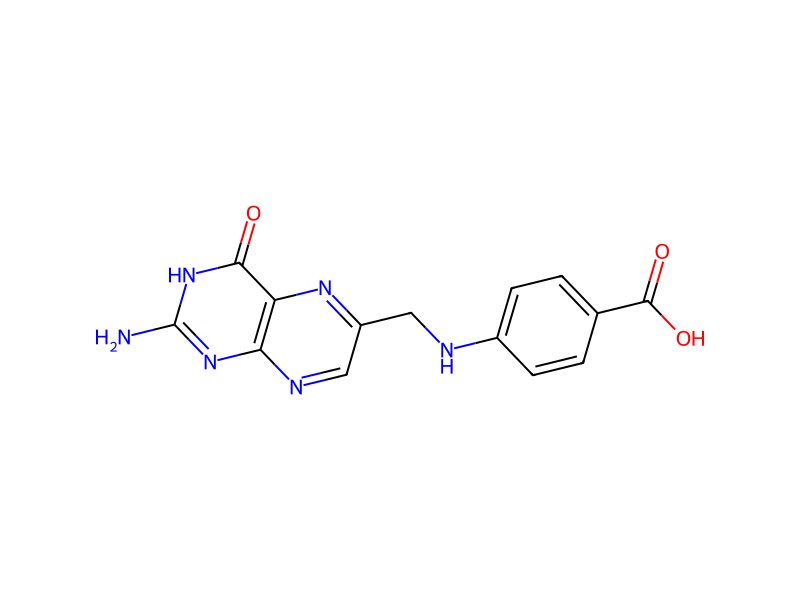
Hydrochloric Acid → Pteroic Acid
Reaction equation

C([NH:4][C:5]1[NH:27][C:26](=[O:28])[C:25]2[C:7](=[N:8][CH:9]=[C:10]([N:24]=2)[CH2:11][NH:12][C:13]2[CH:23]=[CH:22][C:16]([C:17]([O:19]CC)=[O:18])=[CH:15][CH:14]=2)[N:6]=1)(=O)C.Cl>[OH-].[Na+]>[C:17]([OH:19])(=[O:18])[C:16]1[CH:22]=[CH:23][C:13]([NH:12][CH2:11][C:10]2[N:24]=[C:25]3[C:7]([N:6]=[C:5]([NH:27][C:26]3=[O:28])[NH2:4])=[N:8][CH:9]=2)=[CH:14][CH:15]=1Participants
4
Reactant 2


Product 1
Reagents, catalysts & solvents 1

Conditions
- Temperature
- 20 °C
Procedure
The ester (2.64 g) is hydrolyzed by heating with 350 ml of 0.1 N sodium hydroxide at 100° C for 30 minutes (under nitrogen and protected from light). The solution is cooled to 20° C and adjusted to pH 3 with concentrated hydrochloric acid. The precipitate is collected by centrifugation at 300 rpm. After washing twice with water and freeze drying, the product pteroic acid is obtained.
Workup
- customThe precipitate is collected by centrifugation at 300 rpm
- washAfter washing twice with water and freeze
- customdrying
Sources & evidence
- ORD record
- ord-0c954ba6682a4ef2b89b217437e56b9b
- Source dataset
- uspto-grants-1976_11
- Patent number
- US03989812
Reaction notes
Loading…