Hydrochloric Acid → Dicumyl peroxide
Reaction equation

Cl.[O-:2][OH:3].[C:4]1([CH:10]([CH3:12])[CH3:11])[CH:9]=[CH:8][CH:7]=[CH:6][CH:5]=1>C(O)(C)(C)C>[C:10]([O:2][O:3][C:10]([C:4]1[CH:9]=[CH:8][CH:7]=[CH:6][CH:5]=1)([CH3:12])[CH3:11])([C:4]1[CH:9]=[CH:8][CH:7]=[CH:6][CH:5]=1)([CH3:12])[CH3:11]Participants
Reactant 2

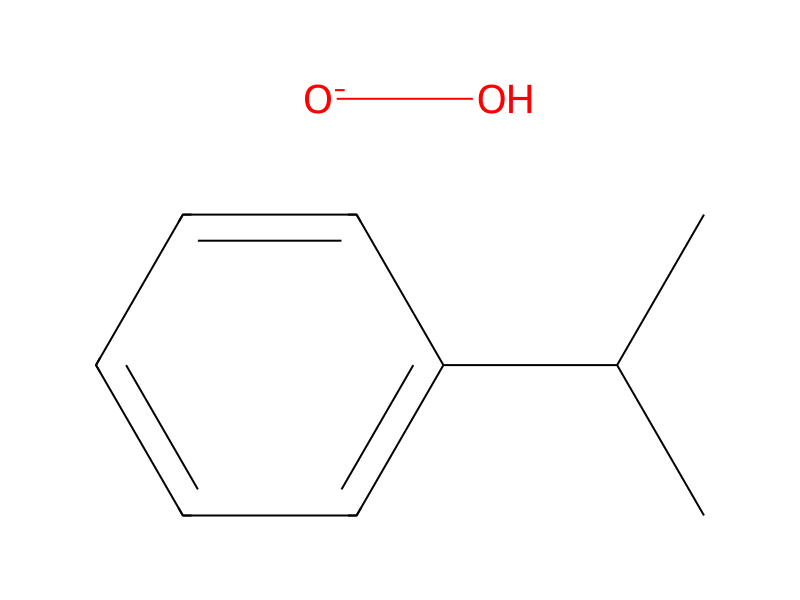
Product 1

Reagents, catalysts & solvents 1

Procedure
The fourth method is the only method relevant to this invention. The other methods and their short-comings in the preparation of cumyl peroxide are thoroughly discussed in U.S. Pat. No. 4,133,835 (Bafford). This invention is essentially an improvement over Bafford's process as taught in U.S. Pat. No. 4,133,835. Prior art pertaining to the fourth method above is: Kato et. al. (Auslegeschrift No. 2,035,127) published a process for preparing t-cumyl type peroxides by reacting a tertiary hydroperoxide with an aralkyl halide, such as t-cumyl chloride, at 0°-80° C. in the presence of an acid binding agent such as a t-alcohol or an aliphatic olefin. The mole ratio of the aralkyl halide to the hydroperoxide could vary from 1:1 to 1:1.5. In this process the hydroperoxide reacts with the aralkyl halide to form the peroxide; the HCl generated is taken up by the acid binding agent. There is no regeneration of the t-cumyl chloride. Kato's process was run with an acid sensitive aralkyl hydroperoxide, cumene hydroperoxide, with t-cumyl chloride in the presence of t-butyl alcohol (see Example XX). Although the reaction ran quite fast, only a 36% yield of dicumyl peroxide was obtained. There was a considerable amount of phenol generated during the reaction indicating the t-butyl alcohol was not a good scavenger of the hydrogen chloride; consequently a large amount of the cumene hydroperoxide underwent acid catalyzed decomposition to form phenol and acetone.
Sources & evidence
- ORD record
- ord-fa38afc4bd4e4d36bab43d260549a94a
- Source dataset
- uspto-grants-1980_12
- Patent number
- US04241222
Reaction notes
Loading…