Potassium Persulfate → 4-Bromo-2,3-dihydro-2,2-dimethyl-3-benzofuranone
Reaction equation

[Br:1][C:2]1[C:7]2[CH2:8][C:9]([CH3:12])([CH3:11])[O:10][C:6]=2[CH:5]=[CH:4][CH:3]=1.S(OOS([O-])(=O)=O)([O-])(=O)=[O:14].[K+].[K+]>O.C(#N)C.O.O.O.O.O.S([O-])([O-])(=O)=O.[Cu+2]>[Br:1][C:2]1[C:7]2[C:8](=[O:14])[C:9]([CH3:12])([CH3:11])[O:10][C:6]=2[CH:5]=[CH:4][CH:3]=1Participants
Reactant 2
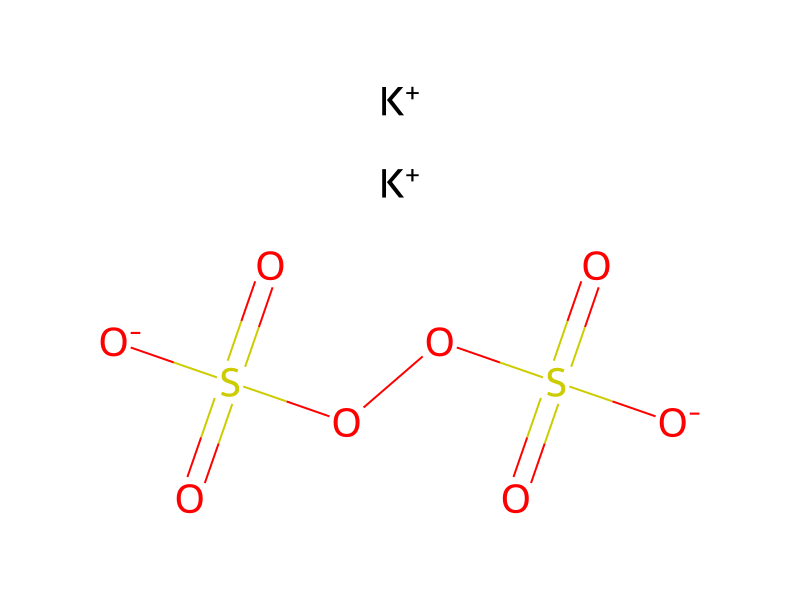

Product 1

Reagents, catalysts & solvents 3



Procedure
Under a nitrogen atmosphere, a stirred solution of 3.0 grams (0.013 mole) 4-bromo-2,3-dihydro-2,2-dimethylbenzofuran, 10.7 grams (0.039 mole) of potassium persulfate, and 3.3 grams (0.013 mole) of copper(II) sulfate pentahydrate in 30 mL of water and 30 mL of acetonitrile is heated at reflux for one hour. After this time the reaction mixture is poured into 200 mL of water. The mixture is then extracted with one 200 mL portion of diethyl ether. The extract is dried with magnesium sulfate and filtered. The filtrate is concentrated under reduced pressure to a residual oil. The oil is subjected to column chromatography on silica gel. Elution is accomplished using 1:1 petroleum ether and methylene chloride. The product-containing fractions are combined and concentrated under reduced pressure, yielding 2.1 grams of 4-bromo-2,3-dihydro-2,2-dimethyl-3-benzofuranone. The NMR spectrum is consistent with the proposed structure.
Workup
- temperatureat reflux for one hour
- extractionThe mixture is then extracted with one 200 mL portion of diethyl ether
- dry with materialThe extract is dried with magnesium sulfate
- filtrationfiltered
- concentrationThe filtrate is concentrated under reduced pressure to a residual oil
- washElution
- concentrationconcentrated under reduced pressure
Sources & evidence
- ORD record
- ord-45b9a910c51a400aafaadba148d8fa2f
- Source dataset
- uspto-grants-1996_07
- Patent number
- US05532370
Reaction notes
Loading…