Pyridine → 2,5-Bis[(trifluoromethyl)sulfanyl]-1H-pyrrole
Reaction equation

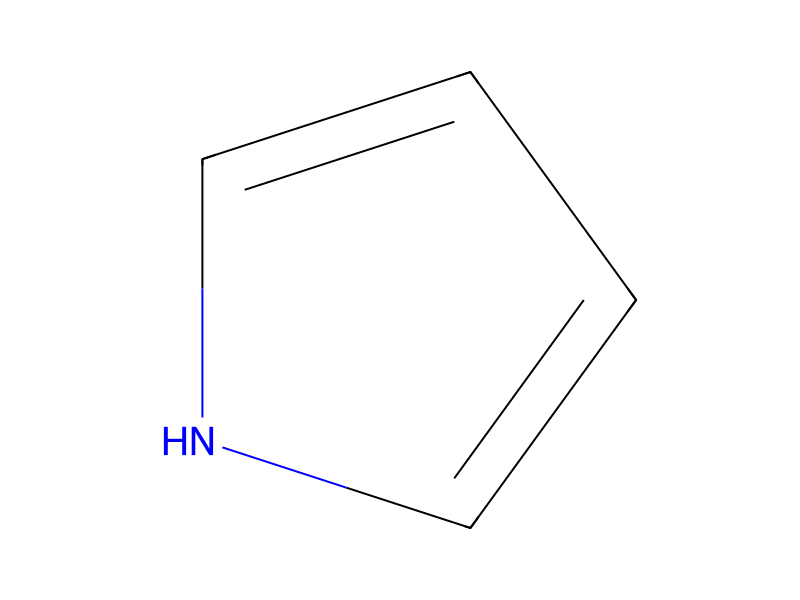
[F:1][C:2]([F:6])([F:5])[S:3]Cl.[NH:7]1[CH:11]=[CH:10][CH:9]=[CH:8]1.[N:12]1[CH:17]=[CH:16][CH:15]=[CH:14]C=1>C(=O)=O.C(Cl)(Cl)Cl.[Fe]>[F:1][C:2]([F:6])([F:5])[S:3][C:8]1[NH:7][C:11]([S:3][C:2]([F:6])([F:5])[F:1])=[CH:10][CH:9]=1.[F:1][C:2]([F:6])([F:5])[S:3][C:17]1[NH:12][CH:14]=[C:15]([S:3][C:2]([F:6])([F:5])[F:1])[CH:16]=1Participants
8
Reactant 3


Product 2


Reagents, catalysts & solvents 3



Procedure
25 g of trifluoromethanesulfenyl chloride was condensed in a pressured bottle in dry ice and 2.34 g of pyrrole in 40 ml of anhydrous chloroform, 12.1 g of pyridine and 0.8 g of iron powder were added. The mixture was then stirred at room temperature for 3 days. It was then filtered to remove insoluble materials. The mixture was washed with water, diluted hydrochloric acid and water again. After evaporation of the solvent, the residue was distilled under vacuum, giving 4.2 g of 2,5-bis(trifluoromethylthio)pyrrole and 3.5 g 2,4-bis(trifluoromethylthio)pyrrole. The total yield was 82%.
Workup
- filtrationIt was then filtered
- customto remove insoluble materials
- washThe mixture was washed with water, diluted hydrochloric acid and water again
- customAfter evaporation of the solvent
- distillationthe residue was distilled under vacuum
Sources & evidence
- ORD record
- ord-97155b9936e34cadbc7e11a8c90454f4
- Source dataset
- uspto-grants-1996_07
- Patent number
- US05538812
Reaction notes
Loading…