Water → 2-(3-Phenylpropyl)-6-bromo-1-oxo-1,2,3,4-tetrahydroisoquinoline
Reaction equation

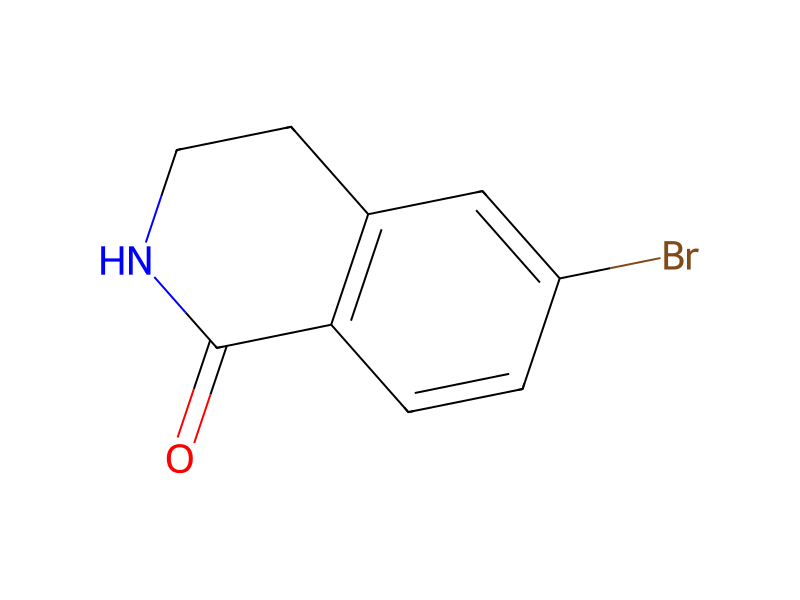
[Br:1][C:2]1[CH:3]=[C:4]2[C:9](=[CH:10][CH:11]=1)[C:8](=[O:12])[NH:7][CH2:6][CH2:5]2.Br[CH2:14][CH2:15][CH2:16][C:17]1[CH:22]=[CH:21][CH:20]=[CH:19][CH:18]=1.[H-].[Na+].O>CN(C=O)C>[C:17]1([CH2:16][CH2:15][CH2:14][N:7]2[CH2:6][CH2:5][C:4]3[C:9](=[CH:10][CH:11]=[C:2]([Br:1])[CH:3]=3)[C:8]2=[O:12])[CH:22]=[CH:21][CH:20]=[CH:19][CH:18]=1Participants
6





Procedure
To a solution of 6-bromo-1-oxo-1,2,3,4-tetrahydroisoquinoline (2.82 g, 12.5 mmol) in DMF (80 ml) is added 1-bromo-3-phenylpropane (2.89 ml, 18.75 mmol), KI (200 mg, 1.25 mmol) and NaH (600 mg, 25 mmol). The reaction mixture is stirred for 3 hours and subsequently poured into H2O (300 ml). The resulting emulsion is extracted with EtOAc (2×150 mL) and the organic phase washed with 2N HCl (1×200 mL), H2O (1×200 mL), saturated NaHCO3 solution (1×200 mL), saturated NaCl solution (2×200 mL), dried over MgSO4 and concentrated in vacuo. The residue is chromatographed (silica gel, 9:1 hexane/EtOAc) to give 2-(3-phenylpropyl)-6-bromo-1-oxo-1,2,3,4-tetrahydroisoquinoline.
Workup
- extractionThe resulting emulsion is extracted with EtOAc (2×150 mL)
- washthe organic phase washed with 2N HCl (1×200 mL), H2O (1×200 mL), saturated NaHCO3 solution (1×200 mL), saturated NaCl solution (2×200 mL)
- dry with materialdried over MgSO4
- concentrationconcentrated in vacuo
- customThe residue is chromatographed (silica gel, 9:1 hexane/EtOAc)
Sources & evidence
- ORD record
- ord-4235efeaecf74e3ea278998bd540f58c
- Source dataset
- uspto-grants-1994_08
- Patent number
- US05334600
Reaction notes
Loading…