Glycolide → HCID 131718652, compound
Reaction equation

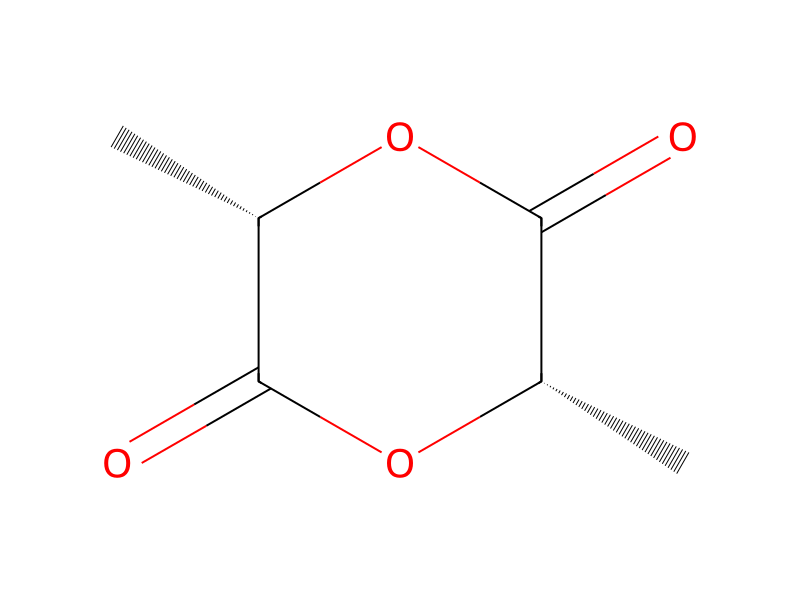
[CH3:1][C@@H:2]1[O:9][C:7](=[O:8])[C@H:6]([CH3:10])[O:5][C:3]1=[O:4].[CH2:11]1[O:18][C:16](=[O:17])[CH2:15][O:14][C:12]1=[O:13]>>[CH3:1][C@@H:2]1[O:9][C:7](=[O:8])[C@H:6]([CH3:10])[O:5][C:3]1=[O:4].[CH2:11]1[O:18][C:16](=[O:17])[CH2:15][O:14][C:12]1=[O:13].[C:7]1(=[O:8])[O:9][CH2:2][CH2:3][CH2:11][CH2:10][CH2:6]1Participants
3


Conditions
- Temperature
- 200 °C
Procedure
l-Lactide (l-Lac, 153.3 grams) and Glycolide (Gly, 17.0 grams) were melted and charged into the reactor. The contents were stirred at 200° C. for 2 hours at which point the mixture had again obtained maximum melt viscosity. The polymer was discharged from the reactor, ground, and dried in a vacuum oven at 100° C. and 0.2 mm Hg. The polymer had in inherent viscosity of 1.40 dL/g in chloroform, measured at 30° C. on a 0.5% solution. The polymer composition, as measured by 1H-NMR spectroscopy was 15.9/74.1/10.0 weight percent CAP/l-LAC/Gly.
Workup
- additioncharged into the reactor
- customdried in a vacuum oven at 100° C.
- custommeasured at 30° C. on a 0.5% solution
Sources & evidence
- ORD record
- ord-2c857926cf0c42938fc6bd78021b3d47
- Source dataset
- uspto-grants-1994_08
- Patent number
- US05342395
Reaction notes
Loading…