Diethyl Ether → HCID 90413397, compound
Reaction equation

[Cl:1][C:2]1[C:10]2[O:9][C:8]([F:12])([F:11])[O:7][C:6]=2[CH:5]=[CH:4][CH:3]=1.[Li+].CCC[CH2-].C(O[B:22]1[O:26][C:25]([CH3:28])([CH3:27])[C:24]([CH3:30])([CH3:29])[O:23]1)(C)C.C(OCC)C>O1CCCC1>[Cl:1][C:2]1[C:10]2[O:9][C:8]([F:12])([F:11])[O:7][C:6]=2[C:5]([B:22]2[O:26][C:25]([CH3:28])([CH3:27])[C:24]([CH3:30])([CH3:29])[O:23]2)=[CH:4][CH:3]=1Participants

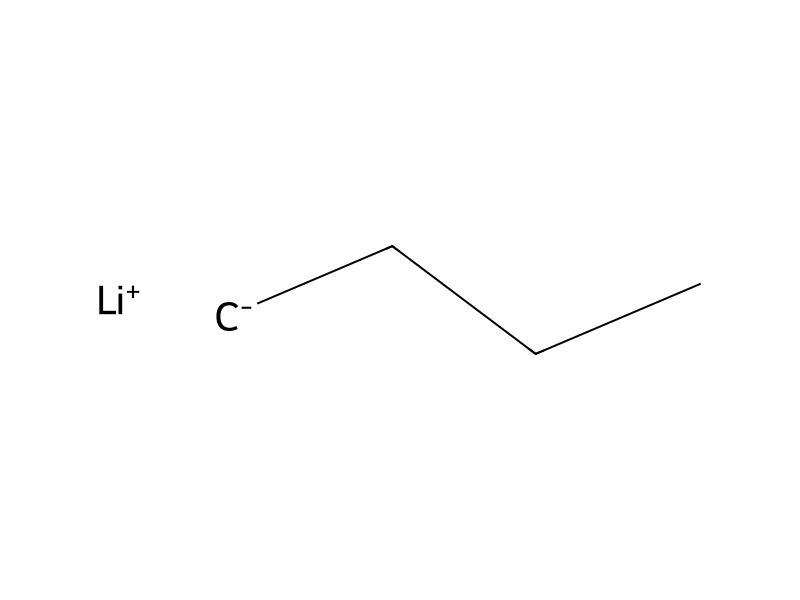



Conditions
- Temperature
- -75 °C
Procedure
4-Chloro-2,2-difluorobenzo[d][1,3]dioxole (3 g, 15.58 mmol) was dissolved in tetrahydrofuran (50 mL) and cooled to −75° C. N-Butyllithium (2.5 M in hexanes; 6.86 mL, 17.14 mmol) was added dropwise keeping the temperature below −65° C. The reaction mixture was then stirred at −75° C. for 1 h to ensure complete deprotonation. 2-Isopropoxy-4,4,5,5-tetramethyl-1,3,2-dioxaborolane (3.19 g, 17.14 mmol) was then added to the reaction mixture dropwise keeping the temperature below −65° C. The reaction mixture was then allowed to warm to room temperature, added to diethyl ether (200 mL) and extracted with water (2×100 mL). The aqueous phases were combined and acidified to pH 4 with concentrated HCl. The product was extracted with diethyl ether and the organic phase was dried and concentrated under vacuum to provide the title compound as an off-white solid (3.82 g, 77%): 1H NMR (400 MHz, CDCl3) δ 7.38 (d, J=8.4 Hz, 1H), 7.06 (d, J=8.4 Hz, 1H), 1.36 (s, 12H); EIMS m/z 318.
Workup
- customthe temperature below −65° C
- customthe temperature below −65° C
- temperatureto warm to room temperature
- extractionextracted with water (2×100 mL)
- extractionThe product was extracted with diethyl ether
- customthe organic phase was dried
- concentrationconcentrated under vacuum
Sources & evidence
- ORD record
- ord-d07df1944d6e4717a0a54eb2f6ccbf71
- Source dataset
- uspto-grants-2015_10
- Patent number
- US09149038B2
Reaction notes
Loading…