Octadecylamine → HCID 75201794, compound
Reaction equation

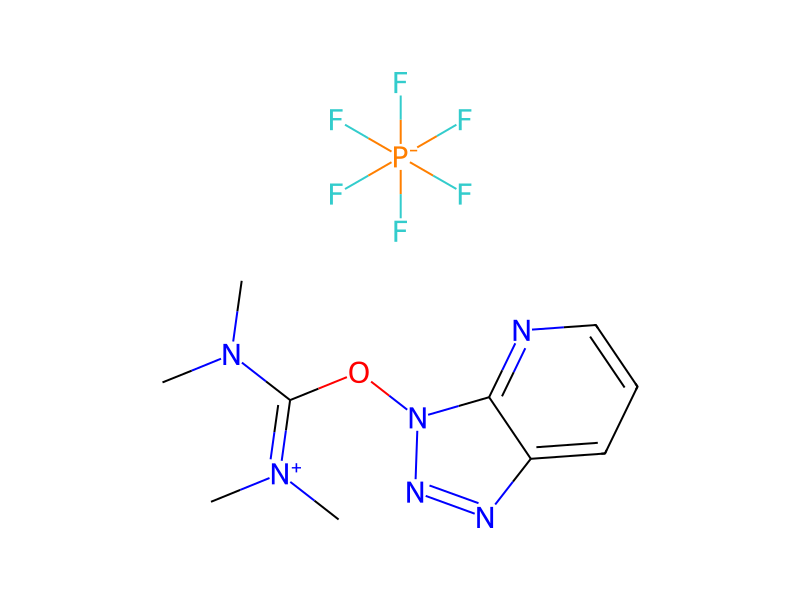
[CH3:1][N:2]1[C:10]([CH2:11][CH2:12][CH2:13][C:14]([OH:16])=O)=[N:9][C:8]2[CH:7]=[C:6]([N:17]([CH2:21][CH2:22][Cl:23])[CH2:18][CH2:19][Cl:20])[CH:5]=[CH:4][C:3]1=2.Cl.CN(C(ON1N=NC2C=CC=NC1=2)=[N+](C)C)C.F[P-](F)(F)(F)(F)F.C(N(CC)C(C)C)(C)C.[CH2:58]([NH2:76])[CH2:59][CH2:60][CH2:61][CH2:62][CH2:63][CH2:64][CH2:65][CH2:66][CH2:67][CH2:68][CH2:69][CH2:70][CH2:71][CH2:72][CH2:73][CH2:74][CH3:75]>CN(C)C=O>[Cl:20][CH2:19][CH2:18][N:17]([CH2:21][CH2:22][Cl:23])[C:6]1[CH:5]=[CH:4][C:3]2[N:2]([CH3:1])[C:10]([CH2:11][CH2:12][CH2:13][C:14]([NH:76][CH2:58][CH2:59][CH2:60][CH2:61][CH2:62][CH2:63][CH2:64][CH2:65][CH2:66][CH2:67][CH2:68][CH2:69][CH2:70][CH2:71][CH2:72][CH2:73][CH2:74][CH3:75])=[O:16])=[N:9][C:8]=2[CH:7]=1Participants
Reactant 4



Product 1

Reagents, catalysts & solvents 1

Conditions
- Temperature
- 2 °C
Procedure
A 250 mL three neck round bottom flask equipped with a stir bar, thermocouple, cooling bath, 60 mL pressure equalizing dropping funnel and nitrogen in/outlet was charged with 10.0 g (25.3 mmol) of bendamustine hydrochloride, 10.6 g (27.8 mmol) of HATU and 100 mL of N,N-dimethylformamide (DMF). To this stirred yellow solution was added 4.41 mL (3.27 g, 25.3 mmol) of N,N-diisopropylethylamine (DIPEA). An exotherm to 27.1° C. was noted and the solution became a darker yellow. The reaction was cooled to 2.0° C. where a suspension of 6.2 mL (4.59 g, 35.5 mmol) of DIPEA, 7.65 g (25.6 mmol) of octadecyl amine in 0 mL of DMF was added via pipette. Once addition was complete the reaction became very thick and difficult to stir. It was warmed to room temperature and the magnetic stir bar was replaced with an overhead stirrer. The batch was stirred at RT overnight after which time an in process analysis indicated the reaction was complete. The batch was quenched onto 300 mL of DI water and extracted with dichloromethane (2×150 mL). The organic phases were combined, washed with 10% sodium hydrogen phosphate (1×300 mL), 8% aqueous sodium bicarbonate (1×300 mL) and brine (1×300 mL) before drying over sodium sulfate, filtering and concentrating to dryness in vacuo. The residue was purified by chromatography using 100 g of silica gel 60, 230-400 mesh, eluting with 1% MeOH/MDC (2 L), 2.5% MeOH/MDC (1 L) and 5% MeOH/MDC (1 L) collecting ˜100 mL fractions. The product containing fractions were combined and concentrated to dryness in vacuo to yield 5.11 g (8.38 mmol, 33%) of the desired product as a white solid with an HPLC purity of 90.9 A %. The major impurity was shown to be the C-16 amide which results from an impurity in the starting amine 1H NMR (400 MHz, DMSO-d6) δ 7.72 (s, b, 1H), 7.33 (d, J=8.84 Hz, 1H), 6.91 (d, J=2.22 Hz, 1H), 6.80 (dd, J=2.36, 8.84 Hz), 3.71 (s, 8H), 3.70 (s, 3H), 3.01 (q, J=6.8, 12.68, 2H), 2.79 (t, J=7.44 Hz, 2H), 2.18 (t, J=7.36 Hz, 2H), 1.97 (m, 2H), 1.36 (m, 2H), 1.28 (s, b, 30H), 0.85 (t, J=6.32 Hz, 3H).
Workup
- temperaturethermocouple, cooling bath
- customto 27.1° C.
- additionwas added via pipette
- additionOnce addition
- temperatureIt was warmed to room temperature
- customthe magnetic stir bar was replaced with an overhead stirrer
- stirringThe batch was stirred at RT overnight after which time an in process analysis
- customThe batch was quenched onto 300 mL of DI water
- extractionextracted with dichloromethane (2×150 mL)
- washwashed with 10% sodium hydrogen phosphate (1×300 mL), 8% aqueous sodium bicarbonate (1×300 mL) and brine (1×300 mL)
- dry with materialbefore drying over sodium sulfate
- filtrationfiltering
- concentrationconcentrating to dryness in vacuo
- customThe residue was purified by chromatography
- washeluting with 1% MeOH/MDC (2 L), 2.5% MeOH/MDC (1 L) and 5% MeOH/MDC (1 L)
- customcollecting ˜100 mL fractions
- additionThe product containing fractions
- concentrationconcentrated to dryness in vacuo
Sources & evidence
- ORD record
- ord-ea75616efc8a40b49d15652d35a3cea7
- Source dataset
- uspto-grants-2015_10
- Patent number
- US09150517B2
Reaction notes
Loading…