Hydrochloric Acid → 5-Bromo-2-(2,2-dimethylpropionylamino)-3-hydroxybenzoic Acid
Reaction equation
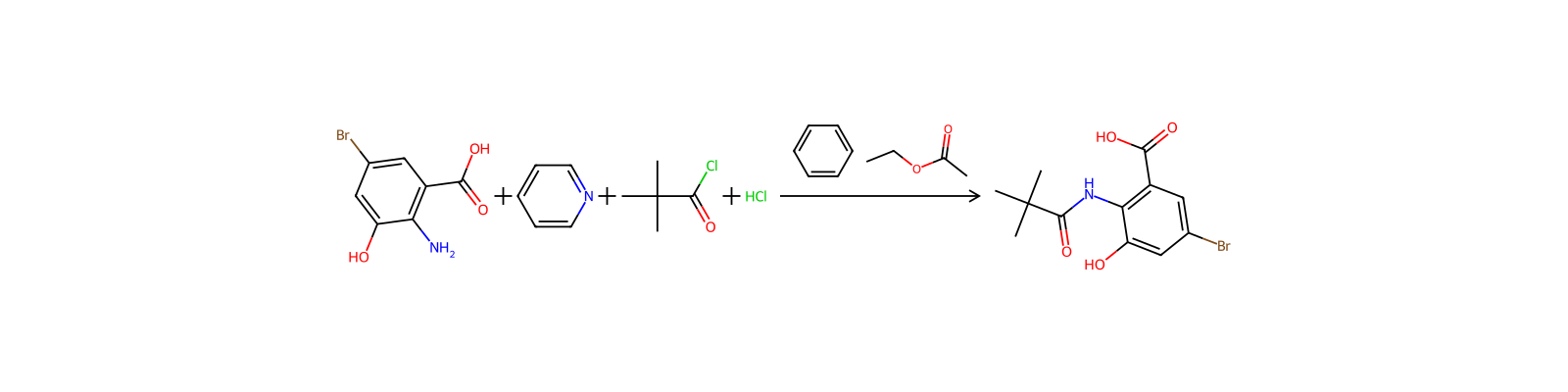
[NH2:1][C:2]1[C:10]([OH:11])=[CH:9][C:8]([Br:12])=[CH:7][C:3]=1[C:4]([OH:6])=[O:5].N1C=CC=CC=1.[C:19](Cl)(=[O:24])[C:20]([CH3:23])([CH3:22])[CH3:21].Cl>C1C=CC=CC=1.C(OCC)(=O)C>[Br:12][C:8]1[CH:9]=[C:10]([OH:11])[C:2]([NH:1][C:19](=[O:24])[C:20]([CH3:23])([CH3:22])[CH3:21])=[C:3]([CH:7]=1)[C:4]([OH:6])=[O:5]Participants
Reactant 4




Product 1

Reagents, catalysts & solvents 2


Conditions
- Temperature
- 85 °C
Procedure
2-Amino-5-bromo-3-hydroxybenzoic acid (I-219) (11.92 g, 51.37 mmol) was dissolved in benzene (360 ml), and pyridine (12.5 m, 154.12 mmol) and pivaloyl chloride (19.0 ml, 154.12 mmol) were added at room temperature. After stirred at 85° C. under nitrogen atmosphere for 3.5 hours, this was cooled to room temperature. The solution was fractionated with ethyl acetate and aqueous 1 M hydrochloric acid solution. The organic layer was washed with saturated brine, and dried over anhydrous sodium sulfate. The solvent was evaporated away under reduced pressure, and the resulting residue was subjected to column chromatography with silica gel, and the fraction with hexane:ethyl acetate=95:5 gave the entitled compound (15.98 g, 98.4%) as a brown solid.
Workup
- temperaturethis was cooled to room temperature
- washThe organic layer was washed with saturated brine
- dry with materialdried over anhydrous sodium sulfate
- customThe solvent was evaporated away under reduced pressure
Sources & evidence
- ORD record
- ord-cc29d5cd193d4f24af7263ab2dc7c705
- Source dataset
- uspto-grants-2010_06
- Patent number
- US07737166B2
Reaction notes
Loading…