Tetrahydrofuran → Boronic Acid
Reaction equation

[CH:1]1[CH:6]=[CH:5][C:4]([N:7]([C:14]2[CH:19]=[CH:18][C:17](Br)=[CH:16][CH:15]=2)[C:8]2[CH:13]=[CH:12][CH:11]=[CH:10][CH:9]=2)=[CH:3][CH:2]=1.O1CCCC1.[Li]CCCC.CCCCCC.[B:37](OC(C)C)([O:42]C(C)C)[O:38]C(C)C>O>[BH:37]([OH:42])[OH:38].[C:14]1([N:7]([C:4]2[CH:3]=[CH:2][CH:1]=[CH:6][CH:5]=2)[C:8]2[CH:13]=[CH:12][CH:11]=[CH:10][CH:9]=2)[CH:15]=[CH:16][CH:17]=[CH:18][CH:19]=1.[BH:37]([OH:42])[OH:38]Participants




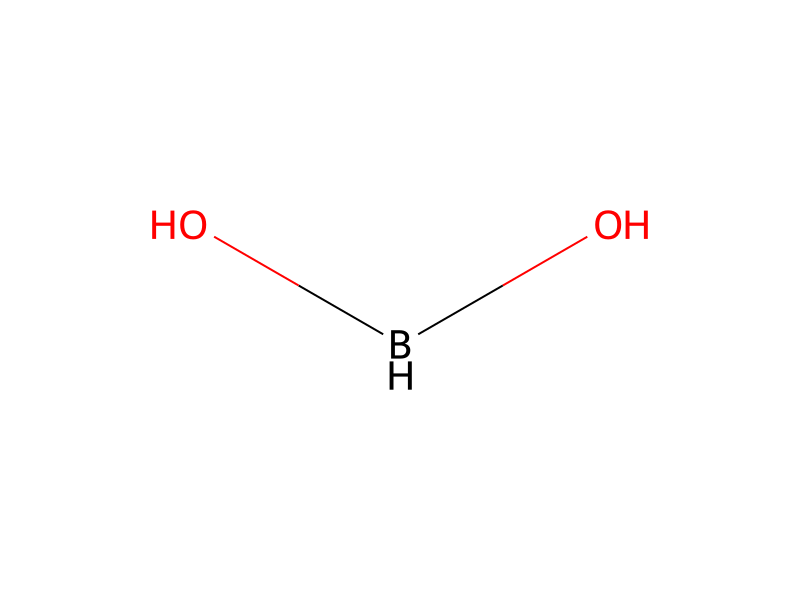


Procedure
Also, triphenylamine boronic acid product was synthesized as follows. Under an argon (Ar) atmosphere, 246 g of 4-bromotriphenylamine (commercially available product), and 1500 ml of anhydrous tetrahydrofuran were placed in a 5 liter flask, and 570 ml of 1.6M n-BuLi/hexane solution was added dropwise over 3 hours at −60° C. After 30 minutes, 429 g of triisopropyl borate was added dropwise over 1 hour. Then, reaction overnight at ambient temperature was allowed. After the reaction, 2 liters of water was added dropwise, and after that, the mixture was extracted and the liquid was separated using 2 liters of toluene. The organic layer was concentrated, recrystallized, filtered, dried and 160 g of white boronic acid product, a target compound, was obtained.
Workup
- customThen, reaction overnight at ambient temperature
- additionwas added dropwise
- extractionafter that, the mixture was extracted
- customthe liquid was separated
- concentrationThe organic layer was concentrated
- customrecrystallized
- filtrationfiltered
- customdried
Sources & evidence
- ORD record
- ord-a012cd0d25594700943fbbf2ddd392dd
- Source dataset
- uspto-grants-2015_10
- Patent number
- US09159932B2
Reaction notes
Loading…