Broxyquinoline → 5,7-Dibromo-8-[(propan-2-yl)oxy]quinoline
Reaction equation
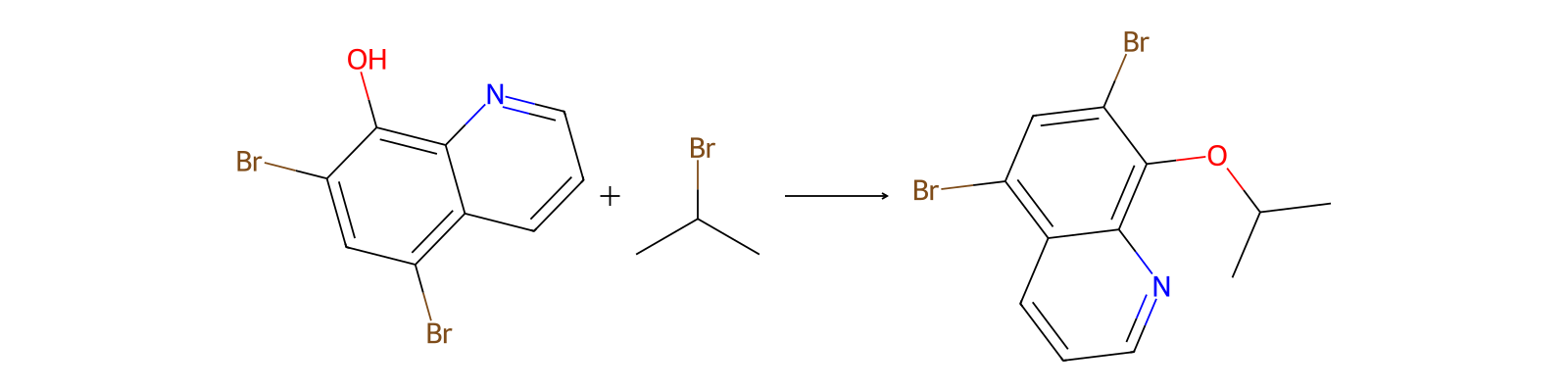
[Br:1][C:2]1[CH:11]=[C:10]([Br:12])[C:9]([OH:13])=[C:8]2[C:3]=1[CH:4]=[CH:5][CH:6]=[N:7]2.Br[CH:15]([CH3:17])[CH3:16]>>[Br:1][C:2]1[CH:11]=[C:10]([Br:12])[C:9]([O:13][CH:15]([CH3:17])[CH3:16])=[C:8]2[C:3]=1[CH:4]=[CH:5][CH:6]=[N:7]2Participants
3


Procedure
Reaction of 5,7-dibromo-quinolin-8-ol with 2-bromopropane following the method described in Example 8 gave 5,7-dibromo-8-isopropoxy-quinoline 6 (97%): 1H NMR (CDCl3): δ 8.94 (dd, J=1.5 and 4.2, 1 H), 8.48 (dd, J=1.5 and 8.4, 1H), 8.00 (s, 1 H), 7.52 (dd, J=4.2 and 8.4, 1 H), 5.22 (m, 1 H), 1.43 (d, J=6.1, 6 H); mass spectrum: m/z 344, 346, 348 (M++1, 50, 100 and 50%, respectively). Reaction of 6 with aryl boronic acids, and cleavage of the isopropoxy group following the method outlined in Example 8 gave compounds L1 and L2 (data in Table 4).
Sources & evidence
- ORD record
- ord-9cb9524124db486891c0cf872f455f4d
- Source dataset
- uspto-grants-2015_10
- Patent number
- US09169211B2
Reaction notes
Loading…