Phenol → 4-{2-[4-(Methylamino)phenyl]propan-2-yl}phenol
Reaction equation

C1(O)C=CC=CC=1.[CH:8]([C:11]1[CH:16]=[CH:15][C:14]([OH:17])=[CH:13][CH:12]=1)([CH3:10])[CH3:9].OC1C=CC(C(C2C=CC(O)=CC=2)(C)C)=CC=1.C(C1C=CC(O)=CC=1)(C)=C.[CH3:45][NH:46][C:47]1[CH:52]=[CH:51][CH:50]=[CH:49][CH:48]=1.OC1C=CC(C(C2C=CC(N)=CC=2)(C)C)=CC=1>>[OH:17][C:14]1[CH:15]=[CH:16][C:11]([C:8]([C:50]2[CH:51]=[CH:52][C:47]([NH:46][CH3:45])=[CH:48][CH:49]=2)([CH3:10])[CH3:9])=[CH:12][CH:13]=1Participants


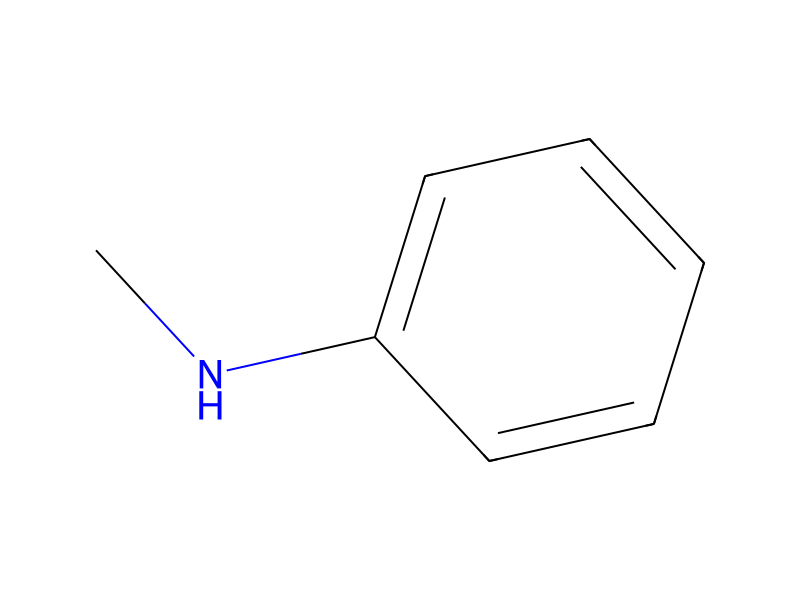


Conditions
- Temperature
- 170 °C
Procedure
N-methylaniline (20 g) was added to 50 g of a mixture of alkenyl phenols and phenol obtained by the alkali cleavage of bisphenol A (consisting of 47.7% of phenol, 1.4% of p-isopropyl phenol, 1.1% of bisphenol A, 21.4% of p-isopropyl phenol monomer, 4.8% of a linear dimer of p-isopropenyl phenol, 4.4% of a linear trimer and higher polymers of p-isopropenyl phenol, and 19.2% of other compounds) (1.62 moles of N-methylaniline per mole of the p-isopropenyl phenol monomeric unit). The mixture was stirred at 170° C. Then, 0.8 g of the catalyst solution prepared in Example 1 (0.0026 mole of catalyst per mole of the p-isopropenyl phenol monomeric unit) was added, and the reaction was performed for 3 hours. Gas-chromatographic analysis of the reaction mixture showed that 0.98 g of bisphenol A and 25.4 g (yield 92%) of 2-(4'-hydroxyphenyl)-2-(4'-methylaminophenyl)-propane having a melting point of 135.5° to 137° C. were formed.
Sources & evidence
- ORD record
- ord-3ad7d558712547e3808c51c0b8d48810
- Source dataset
- uspto-grants-1983_02
- Patent number
- US04374272
Reaction notes
Loading…