Ammonium Chloride → (2,4-Difluorophenyl)(oxo)diphenyl-lambda~5~-phosphane
Reaction equation

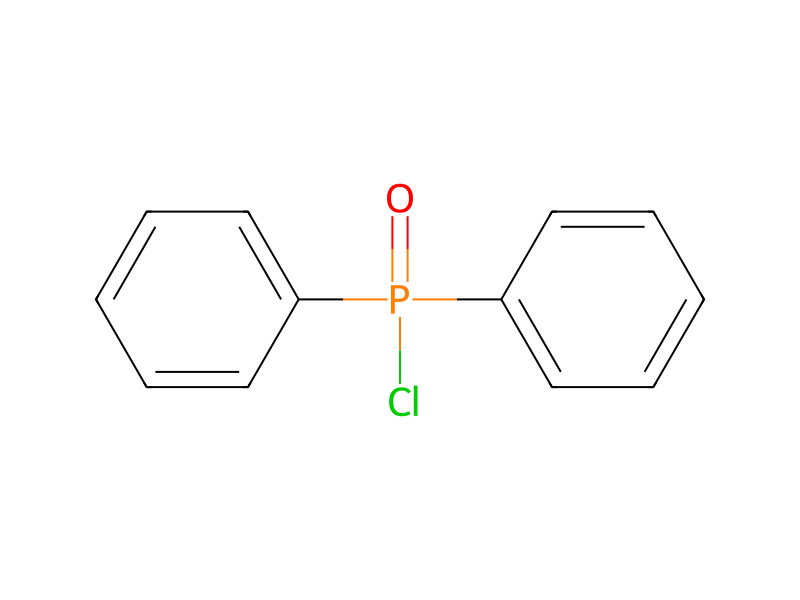
[Mg].Br[C:3]1[CH:8]=[CH:7][C:6]([F:9])=[CH:5][C:4]=1[F:10].[C:11]1([P:17](Cl)([C:19]2[CH:24]=[CH:23][CH:22]=[CH:21][CH:20]=2)=[O:18])[CH:16]=[CH:15][CH:14]=[CH:13][CH:12]=1.[Cl-].[NH4+]>O1CCCC1>[F:10][C:4]1[CH:5]=[C:6]([F:9])[CH:7]=[CH:8][C:3]=1[P:17](=[O:18])([C:19]1[CH:20]=[CH:21][CH:22]=[CH:23][CH:24]=1)[C:11]1[CH:16]=[CH:15][CH:14]=[CH:13][CH:12]=1Participants





Conditions
- Temperature
- 5 °C
Procedure
Into a 1L three neck round bottomed flask equipped with a mechanical stirrer, thermometer, nitrogen gas inlet, pressure equalizing addition funnel, and reflux condenser with drying tube was placed predried magnesium turnings (13.5 g, 0.55 mol) and dry tetrahydrofuran (THF, 50 mL). The mixture was cooled to ˜5° C. using an ice/water bath. A solution of 1-bromo-2,4-difluorobenzene (107.2 g, 0.55 mol, 20% molar excess) in THF (200 mL) was placed in the pressure equalizing addition funnel and added dropwise over a 1.5 hour period. The mixture was allowed to warm to room temperature. The mixture was stirred at room temperature for 3 hours and the flask was subsequently placed in the ice/water bath to cool the solution to ˜5° C. A solution of diphenylphosphinic chloride (107.9, 0.46 mol) in THF (100 mL) was added dropwise over a 1 hour period. The reaction mixture was allowed to warm to room temperature and was stirred under nitrogen for 15 hours. The resultant brown solution was poured into a mixture of concentrated ammonium chloride solution (700 mL) to give two layers. The organic layer was extracted successively with water, 5% aqueous sodium bicarbonate, and water and subsequently dried over magnesium sulfate. The THF was removed via rotoevaporation to give a dark red viscous liquid, 142.8 g, 98% crude yield. The viscous liquid was vacuum distilled (product distilled between 178-181° C.) and a yellow semi-solid was collected (118.6 g, 81% yield). The material was dissolved in 120 mL of hot toluene, treated which charcoal, and filtered while hot through Celite. To the toluene solution was added 120 mL of hexanes. The solution was allowed to cool, with stirring, overnight. A white crystalline material was collected via filtration (100.9 g, 69% yield). The solid exhibited a melting point of 111.1-112.3° C. as determined by differential scanning calorimetry (DSC) at 10° C./min. Anal. Calcd. for C18H13F2OP: C, 68.79%; H, 4.17%; F, 12.09%; P, 9.86%. Found: C, 68.38%; H, 4.26%; F, 11.17%; P, 10.28%. Mass spectroscopic analysis: M+413.2 [C20H13F6OP+].
Workup
- customthermometer, nitrogen gas inlet, pressure equalizing
- additionaddition funnel
- temperaturereflux condenser
- customwith drying tube
- additionaddition funnel
- additionadded dropwise over a 1.5 hour period
- temperatureto warm to room temperature
- temperatureto cool the solution to ˜5° C
- temperatureto warm to room temperature
- stirringwas stirred under nitrogen for 15 hours
- customto give two layers
- extractionThe organic layer was extracted successively with water, 5% aqueous sodium bicarbonate, and water
- dry with materialsubsequently dried over magnesium sulfate
- customThe THF was removed via rotoevaporation
- customto give a dark red viscous liquid, 142.8 g, 98% crude yield
- distillationdistilled
- distillation(product distilled between 178-181° C.)
- customa yellow semi-solid was collected (118.6 g, 81% yield)
- dissolutionThe material was dissolved in 120 mL of hot toluene
- additiontreated which charcoal
- filtrationfiltered while hot through Celite
- additionTo the toluene solution was added 120 mL of hexanes
- temperatureto cool
- stirringwith stirring, overnight
- filtrationA white crystalline material was collected via filtration (100.9 g, 69% yield)
Sources & evidence
- ORD record
- ord-85258550fdcc4ad1aed2b7c8497e7130
- Source dataset
- uspto-grants-2005_01
- Patent number
- US06841652B2
Reaction notes
Loading…