Sodium Hydroxide → p-Dodecyloxybenzaldehyde
Reaction equation

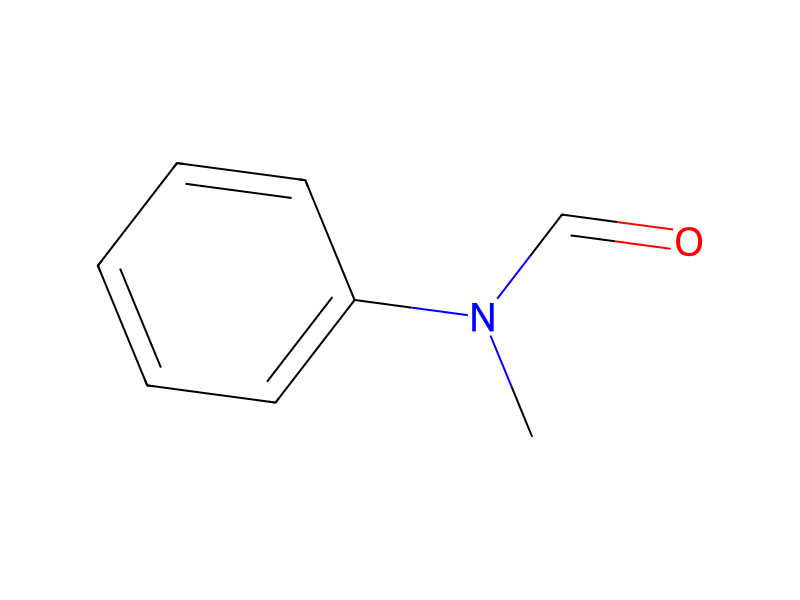
[CH2:1]([O:13][C:14]1[CH:19]=[CH:18][CH:17]=[CH:16][CH:15]=1)[CH2:2][CH2:3][CH2:4][CH2:5][CH2:6][CH2:7][CH2:8][CH2:9][CH2:10][CH2:11][CH3:12].CN([CH:28]=[O:29])C1C=CC=CC=1.O=P(Cl)(Cl)Cl.[OH-].[Na+]>>[CH2:1]([O:13][C:14]1[CH:15]=[CH:16][C:17]([CH:28]=[O:29])=[CH:18][CH:19]=1)[CH2:2][CH2:3][CH2:4][CH2:5][CH2:6][CH2:7][CH2:8][CH2:9][CH2:10][CH2:11][CH3:12]Participants
5




Procedure
Dodecyloxybenzene (2.48 g; 9.45 mmol) is dissolved in N-methylformanilide (195.17 g; 9.45 mmol). POCl3 (1.45 g; 159.33 g; 9.45 mmol) is added dropwise with ice-cooling. Stirring is carried out for 1 hour at 25° C., and then for 3 hours at 60° C. Pouring onto ice is then carried out and the pH is adjusted to 6 using sodium hydroxide solution. Extraction is then carried out with tert-butyl methyl ether (2×50 ml), and the combined organic phases are washed with aqueous NaHCO3 solution and dried over Na2SO4. After filtration, concentration to dryness by evaporation is carried out.
Workup
- temperaturecooling
- waitfor 3 hours at 60° C
- additionPouring onto ice
- extractionExtraction
- washthe combined organic phases are washed with aqueous NaHCO3 solution
- dry with materialdried over Na2SO4
- filtrationAfter filtration, concentration to dryness
- customby evaporation
Sources & evidence
- ORD record
- ord-9af5880bf14344bc89e9c4d3fd366fa5
- Source dataset
- uspto-grants-2005_01
- Patent number
- US06846492B2
Reaction notes
Loading…