Hydrochloric Acid → 4-Vinylphenol
Reaction equation

C([O:5][C:6]1[CH:13]=[CH:12][C:9]([CH:10]=[CH2:11])=[CH:8][CH:7]=1)(C)(C)C.[C:14]([O:18][C:19]12[CH2:28][CH:23]3[CH2:24][CH:25]([CH2:27][CH:21]([CH2:22]3)[CH:20]1O)[CH2:26]2)(=[O:17])[CH:15]=[CH2:16].N(C(C)(C)C(OC)=O)=NC(C)(C)C(OC)=[O:34].Cl>CC(O)C.CCCCCCC.CO>[OH:5][C:6]1[CH:13]=[CH:12][C:9]([CH:10]=[CH2:11])=[CH:8][CH:7]=1.[C:14]([O:18][C:19]12[CH2:28][CH:23]3[CH2:24][CH:25]([CH2:27][C:21]([OH:34])([CH2:22]3)[CH2:20]1)[CH2:26]2)(=[O:17])[CH:15]=[CH2:16]Participants
Reactant 4



Product 2
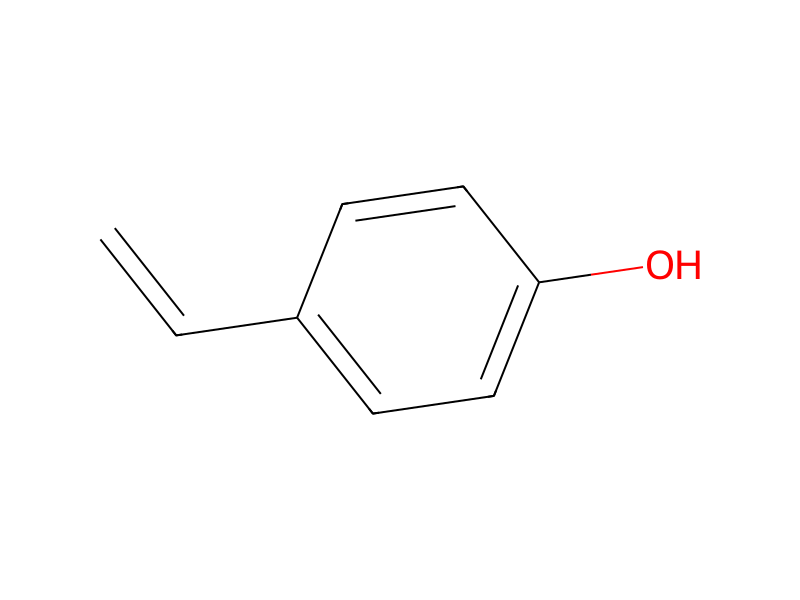

Reagents, catalysts & solvents 3



Conditions
- Temperature
- 75 °C
Procedure
Into a flask was charged 92.8 g (0.53 mol) of 4-tert-butoxystyrene, 13.0 g (0.06 mol) of 3 hydroxy-1-adamantyl acrylate, 52.9 g of methanol and 105.8 g of 2-propanol, and they were refluxed under a nitrogen atmosphere at 75° C. Separately, 6.1 g of dimethyl 2,2′-azobis(2-methylpropionate) was dissolved in 17.6 g of 2-propanol to prepare a solution which was dropped into the above-mentioned monomer solution kept at 75° C. over 30 minutes, then, the resulted mixture was refluxed itself for 8 hours. To this was further added 193.9 g of 2-propanol, and the resulted mixture was refluxed again at 75° C. Into this solution was dropped a mixed solution of 18.3 g of 36% hydrochloric acid and 18.3 g of 2-propanol. Subsequently, the mixture was refluxed for 4 hours at the same temperature to cause hydrolysis, then, the solution was cooled to room temperature. To this reaction mass was added 528.9 g of n-heptane, and the lower resin layer was removed. This resin layer was dissolved in 52.9 g of acetone, and 528.9 g of n-heptane was added, and the lower resin layer was removed again. The resulted resin layer was dissolved in 634.7 g of methyl isobutyl ketone, and 211.6 g of ion exchanged water was added to this and the mixture was stirred and allowed to stand still, then, the organic layer part was removed. Further, an operation of addition of 211.6 g of ion exchanged water, stirring and separation was repeated four times. This organic layer was distilled under reduced pressure until the solution amount after distillation was 230.8 g under conditions of a temperature of 60° C. and a pressure of 80 Torr or less, and dehydrated azeotropically, to obtain a methyl isobutyl ketone solution of a copolymer of 4-hydroxystyrene and 3-hydroxy-1-adamantyl acrylate. The solid concentration of the resulted resin solution was 26.3%, and this copolymer had a weight-average molecular weight of 11400 and a polydispersity of 1.77.
Workup
- customto prepare a solution which
- additionwas dropped into the above-mentioned monomer solution
- temperaturethe resulted mixture was refluxed itself for 8 hours
- temperaturethe resulted mixture was refluxed again at 75° C
- temperatureSubsequently, the mixture was refluxed for 4 hours at the same temperature
- customhydrolysis
- temperaturethe solution was cooled to room temperature
- customthe lower resin layer was removed
- dissolutionThis resin layer was dissolved in 52.9 g of acetone
- addition528.9 g of n-heptane was added
- customthe lower resin layer was removed again
- dissolutionThe resulted resin layer was dissolved in 634.7 g of methyl isobutyl ketone
- additionwas added to this and the mixture
- customthe organic layer part was removed
- additionFurther, an operation of addition of 211.6 g of ion
- stirringstirring
- customseparation
- distillationThis organic layer was distilled under reduced pressure until the solution amount
- distillationafter distillation
- customunder conditions of a temperature of 60° C.
Sources & evidence
- ORD record
- ord-3d164a94b8cc4142b4aee7f526505dd8
- Source dataset
- uspto-grants-2005_01
- Patent number
- US06846609B2
Reaction notes
Loading…