Phenol → Benzyl Phenyl Ether
Reaction equation

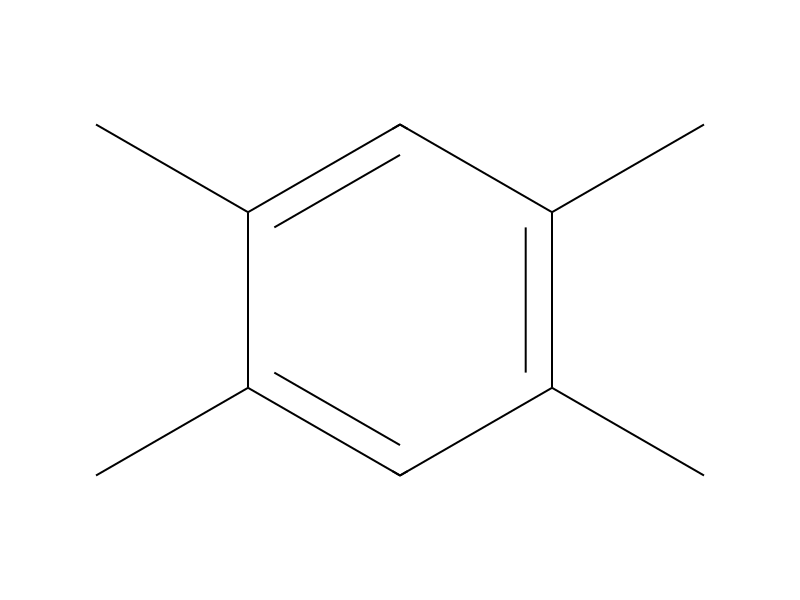
[C:1]1([OH:7])[CH:6]=[CH:5][CH:4]=[CH:3][CH:2]=1.[OH-].[Na+].[I-].[Na+].[CH2:12](Cl)[C:13]1[CH:18]=[CH:17][CH:16]=[CH:15][CH:14]=1.C1(C(=CC(=C(C=1)C)C)C)C>O.CCCCCCCC[N+](CCCCCCCC)(CCCCCCCC)C.[Cl-].C1(C)C=CC=CC=1>[C:1]1([O:7][CH2:12][C:13]2[CH:18]=[CH:17][CH:16]=[CH:15][CH:14]=2)[CH:6]=[CH:5][CH:4]=[CH:3][CH:2]=1Participants








Conditions
- Temperature
- 50 °C
Procedure
Phenol (2.836 g, 30 millimoles, Aldrich, 99+%), sodium hydroxide (1.411 g, 35 millimoles, Merck, 97%), and sodium iodide (0.433 g, 3 millimoles, Aldrich, 98%) were dissolved in water (299.19 g). The excess molar concentration of sodium hydroxide of was 0.166. The aqueous phase was introduced into a 3-neck 500 mL reactor immersed in the water bath at 50° C. The mixture consisting of benzyl chloride (3.930 g, 31 millimoles, Aldrich, 97%), Aliquat 336 (2.597 g, 6 millimoles, Aldrich), durene (0.693 g, 5 millimoles, Aldrich, 98%), and toluene (15.02 g, J. T. Baker, ultra-pure). The organic phase:aqueous phase weight ratio was 1:14. The two phase mixture was stirred mechanically (600 rpm) at 50° C. for 90 minutes. The aliquot of the reaction mixture was centrifuged, the phases were separated and the organic phase was injected into a GC column. The yield of benzyl phenyl ether based on the limiting reactant (phenol) was 70%. No byproducts could be detected in the chromatograms representing the reaction mixture.
Workup
- concentrationThe excess molar concentration of sodium hydroxide
- additionThe aqueous phase was introduced into a 3-neck 500 mL reactor
- customimmersed in the water bath at 50° C
- customthe phases were separated
Sources & evidence
- ORD record
- ord-636551a649c84552b6da2512be5c53e6
- Source dataset
- uspto-grants-2005_01
- Patent number
- US06846946B2
Reaction notes
Loading…