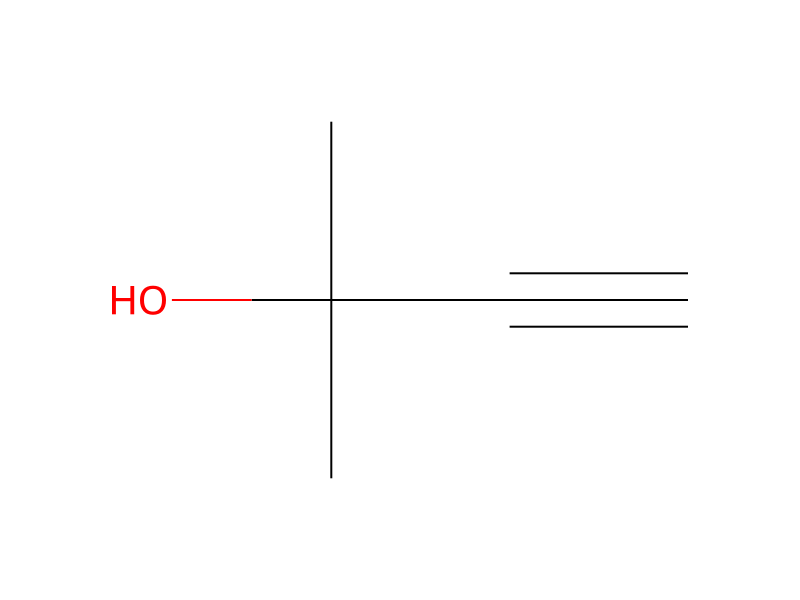
2-Methyl-3-butyn-2-ol → 1-Ethynyl-4-(1-methylethyl)benzene
Reaction equation

[CH3:1][CH:2]([C:4]1[CH:9]=[CH:8][C:7](Br)=[CH:6][CH:5]=1)[CH3:3].[CH3:11][C:12](C)(O)C#C>C(N(CC)CC)C.Cl[Pd](Cl)([P](C1C=CC=CC=1)(C1C=CC=CC=1)C1C=CC=CC=1)[P](C1C=CC=CC=1)(C1C=CC=CC=1)C1C=CC=CC=1.[Cu]I>[CH3:1][CH:2]([C:4]1[CH:9]=[CH:8][C:7]([C:11]#[CH:12])=[CH:6][CH:5]=1)[CH3:3]Participants
Reactant 2

Product 1

Reagents, catalysts & solvents 3



Procedure
A solution of 10 grams (0.050 mole) of 4-(1-methylethyl)bromobenzene and 8.4 grams (0.10 mole) of 1,1-dimethyl-2-propyn-1-ol in 75 mL of triethylamine was stirred, and 0.7 gram (0.001 mole) of bis(triphenylphosphine)palladium(II) chloride and 0.2 gram (0.001 mole) of copper (I) iodide were added. Upon completion of addition the reaction mixture was heated under reflux for four hours. The reaction mixture was cooled and concentrated under reduced pressure to a residue. The residue was dissolved in diethyl ether and was washed first with an aqueous 10% ammonium chloride solution, then with water. The organic layer was dried with magnesium sulfate and filtered. The filtrate was concentrated under reduced pressure to a residual oil. The oil was dissolved in 100 mL of toluene, 4.0 grams of sodium hydroxide was added to the solution, and the mixture was heated under reflux for four hours. The mixture was allowed to cool to ambient temperature where it stood for 18 hours. After this time the mixture was concentrated under reduced pressure to a residual oil. The oil was subjected to column chromatography on silica gel. Elution was accomplished with 1-20% chloroform in hexane. The appropriate fractions were combined and concentrated under reduced pressure to yield 2.4 grams of 4-(1-methylethyl)phenylethyne as an oil. The nmr spectrum was consistent with the proposed structure.
Workup
- additionUpon completion of addition the reaction mixture
- temperaturewas heated
- temperatureunder reflux for four hours
- temperatureThe reaction mixture was cooled
- concentrationconcentrated under reduced pressure to a residue
- dissolutionThe residue was dissolved in diethyl ether
- washwas washed first with an aqueous 10% ammonium chloride solution
- dry with materialThe organic layer was dried with magnesium sulfate
- filtrationfiltered
- concentrationThe filtrate was concentrated under reduced pressure to a residual oil
- dissolutionThe oil was dissolved in 100 mL of toluene
- addition4.0 grams of sodium hydroxide was added to the solution
- temperaturethe mixture was heated
- temperatureunder reflux for four hours
- concentrationAfter this time the mixture was concentrated under reduced pressure to a residual oil
- washElution
- concentrationconcentrated under reduced pressure
Sources & evidence
- ORD record
- ord-0c9f747183b049d8a7f4eb669493d9f0
- Source dataset
- uspto-grants-1989_05
- Patent number
- US04826829
Reaction notes
Loading…