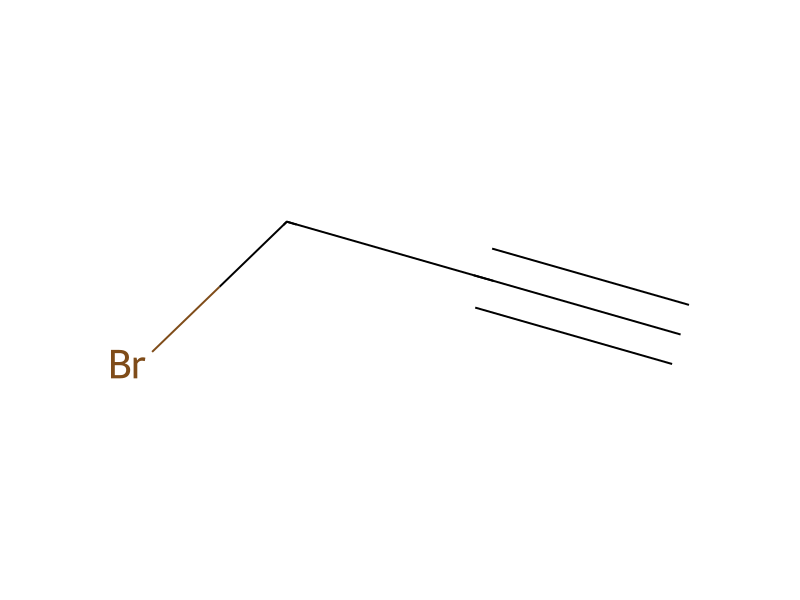
Propargyl bromide → HCID 131715938, compound
Reaction equation

[Mg].[CH2:2](Br)[C:3]#[CH:4].[CH3:6]/[C:7](=[CH:12]\[CH2:13][CH2:14]/[C:15](/[CH3:25])=[CH:16]/[CH2:17][O:18][CH:19]1[CH2:24][CH2:23][CH2:22][CH2:21][O:20]1)/[CH2:8][CH2:9][CH:10]=[O:11].[Cl-].[NH4+]>CCOCC.[Hg](Cl)Cl.O1CCCC1>[CH3:6][C:7](=[CH:12][CH:13]=[CH:14][C:15]([CH3:25])=[CH:16][CH2:17][O:18][CH:19]1[CH2:24][CH2:23][CH2:22][CH2:21][O:20]1)/[CH:8]=[CH:9]/[C:10](/[OH:11])=[CH:4]\[C:3]#[CH:2]Participants






Procedure
4.86 g of magnesium shavings, 100 mg of mercury(II) chloride and 100 ml of ether are placed under an argon atmosphere in a 500 ml sulfonation flask provided with a mechanical stirrer, a dropping funnel and a thermometer. The dropping funnel is charged with a solution of 23.8 g (15.1 ml) of propargyl bromide in 50 ml of ether and 1.0 ml of this solution is added dropwise to the above mixture at room temperature. After the reaction has begun the mixture is cooled to -20° and the remainder of the propargyl bromide solution is added dropwise within 3 hours so that the reaction temperature does not exceed -15°. After completion of the addition the mixture is stirred at -20° for a further 15 minutes. A solution of 28.0 g of (E,E)-4,8-dimethyl-10-[(tetrahyro-2H-pyran-2-yl)-oxy]-4,8-decadienal in 50 ml of ether is then added dropwise at 0°. After the addition of half of this solution a precipitate results, whereupon 100 ml of ether and 100 ml of tetrahydrofuran are added in order to facilitate the stirring. The remainder of the mentioned solution is subsequently added dropwise at 5°-10° and the resulting grey suspension is stirred overnight in a melting ice-bath and then poured into a mixture of ice and saturated ammonium chloride solution. The organic phase is separated and the aqueous phase is extracted twice with hexane. The combined organic phases are washed with saturated ammonium chloride solution, saturated sodium bicarbonate solution and saturated sodium chloride solution, dried over sodium sulphate, filtered and evaporated. The residue is chromatographed on 1.0 kg of silica gel with hexane-ethyl acetate 10%→25%. There is obtained (E,E)-7,11-dimethyl-13-[(tetrahydro-2H-pyran-2-yl)oxy]-7,11-tridecadien-trien-1-yn-4-ol as a yellow oil. IR (film): 3450 (OH); 3307, 2118 (--C≡C--H); 1667 (C=C). MS: 236 (1, (M-dihydro-pyran, C5H8O)+); 218 (0,5, (M-(2-hydroxytetrahydro-pyran, C5H10O2))+); 85 (100, C5H9O+).
Workup
- customprovided with a mechanical stirrer, a dropping funnel
- additionis added dropwise to the above mixture at room temperature
- temperatureis cooled to -20°
- customdoes not exceed -15°
- additionAfter completion of the addition the mixture
- additionAfter the addition of half of this solution a precipitate
- additionare added in order
- additionThe remainder of the mentioned solution is subsequently added dropwise at 5°-10°
- stirringthe resulting grey suspension is stirred overnight in a melting ice-bath
- customThe organic phase is separated
- extractionthe aqueous phase is extracted twice with hexane
- washThe combined organic phases are washed with saturated ammonium chloride solution, saturated sodium bicarbonate solution and saturated sodium chloride solution
- dry with materialdried over sodium sulphate
- filtrationfiltered
- customevaporated
- customThe residue is chromatographed on 1.0 kg of silica gel with hexane-ethyl acetate 10%
Sources & evidence
- ORD record
- ord-229a7c47e3094e7daef47cc9252daaf3
- Source dataset
- uspto-grants-1989_05
- Patent number
- US04827004
Reaction notes
Loading…