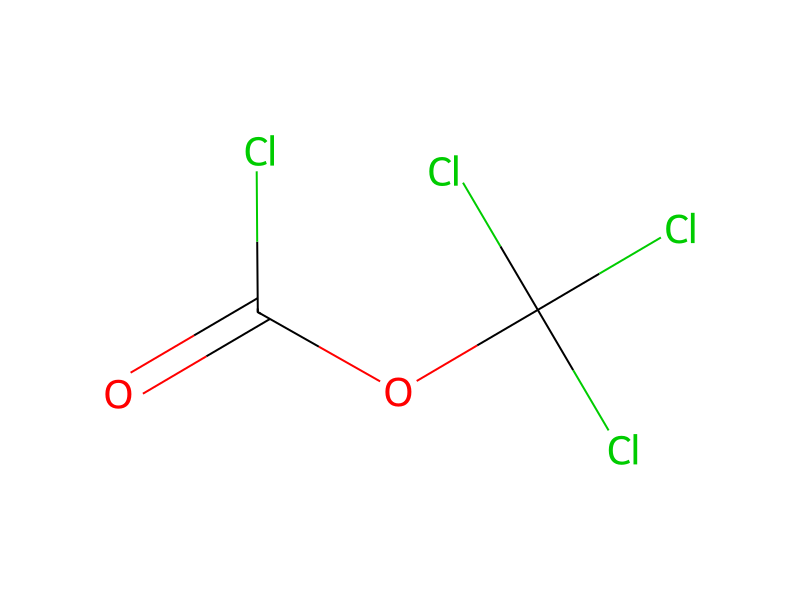
Diphosgene → HCID 14053649, compound
Reaction equation

[F:1][C:2]1[CH:7]=[CH:6][C:5]([N+:8]([O-:10])=[O:9])=[CH:4][C:3]=1[N:11]1[C:19](=O)[C:18]2[CH2:17][CH2:16][CH2:15][CH2:14][C:13]=2[NH:12]1.[Cl:21]C(OC(Cl)(Cl)Cl)=O>C1(C)C=CC=CC=1.ClCCCl>[Cl:21][C:19]1[N:11]([C:3]2[CH:4]=[C:5]([N+:8]([O-:10])=[O:9])[CH:6]=[CH:7][C:2]=2[F:1])[N:12]=[C:13]2[C:18]=1[CH2:17][CH2:16][CH2:15][CH2:14]2Participants
5
Reactant 2

Product 1

Reagents, catalysts & solvents 2


Procedure
To a solution of 2-(2-fluoro-5-nitrophenyl)-1,2,4,5,6,7-hexahydro-3H-indazol-3-one (66.87 g) in toluene (125 ml) and 1,2-dichloroethane (175 ml), there was added trichloromethyl chloroformate (71.57 g), and the resultant mixture was allowed to react in an autoclave at a temperature of 120° to 130° C. under a pressure of 25 kg/cm2 for 3 hours. After cooling, the solvent was removed by distillation. The residue was purified by silica gel column chromatography using a mixture of ethyl acetate and n-hexane (1:6) as an eluent to give 3chloro-2-(2-fluoro-5-nitrophenyl)-4,5,6,7-tetrahydro-2H-indazole. m.p. 109.1° C.
Workup
- customto react in an autoclave at a temperature of 120° to 130° C. under a pressure of 25 kg/cm2 for 3 hours
- temperatureAfter cooling
- customthe solvent was removed by distillation
- customThe residue was purified by silica gel column chromatography
- additiona mixture of ethyl acetate and n-hexane (1:6) as an eluent
Sources & evidence
- ORD record
- ord-be96a15eb47d4898bb574d66b81834ff
- Source dataset
- uspto-grants-1989_05
- Patent number
- US04831150
Reaction notes
Loading…