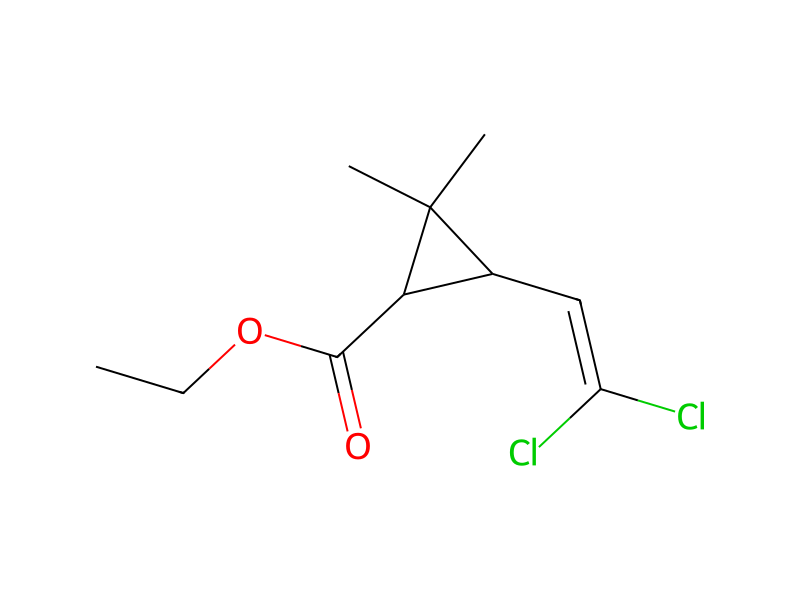
1,8-Diazabicyclo(5.4.0)undec-7-ene → Cyclopropanecarboxylic acid, 3-(2,2-dichloroethenyl)-2,2-dimethyl-, ethyl ester
Reaction equation

[CH3:1][C:2]1([CH3:19])[CH:4]([CH:5]=[C:6]([Cl:8])[Cl:7])[C:3]1(C(OCC)=O)[C:9]([O:11][CH2:12][CH3:13])=[O:10].N12CCCN=C1CCCCC2>C1(C)C(C)=CC=CC=1>[CH3:1][C:2]1([CH3:19])[CH:4]([CH:5]=[C:6]([Cl:7])[Cl:8])[CH:3]1[C:9]([O:11][CH2:12][CH3:13])=[O:10]Participants
4
Reactant 2


Product 1
Reagents, catalysts & solvents 1

Procedure
13 g of diethyl 2,2-dimethyl-3-(2',2'-dichlorovinyl)-cyclopropane-1,1-dicarboxylate were dissolved in 50 g of xylene (technical grade) and 30 g of 1,8-diaza-bicyclo[5.4.0]undec-7-ene were added. The mixture was then heated to the boil for 8 hours. After cooling, ice-cold dilute hydrochloric acid was added so that a neutral or weakly acid pH value resulted. The organic phase was separated off and dried with Na2SO4 and the xylene was distilled off in vacuo. The residue weighed 12.2 g. Fractional distillation gave 3.4 g of ethyl 2,2-dimethyl-3-(2',2'-dichlorovinyl)-cyclopropane-1-carboxylate and also 8.0 g of recovered starting material. The yield was thus 87%.
Workup
- temperatureThe mixture was then heated to the boil for 8 hours
- temperatureAfter cooling
- additionice-cold dilute hydrochloric acid was added so that a neutral or weakly acid
- customresulted
- customThe organic phase was separated off
- dry with materialdried with Na2SO4
- distillationthe xylene was distilled off in vacuo
- distillationFractional distillation
Sources & evidence
- ORD record
- ord-d92f8cceed1f4ec7a8ee2b2d8681379f
- Source dataset
- uspto-grants-1978_09
- Patent number
- US04113969
Reaction notes
Loading…