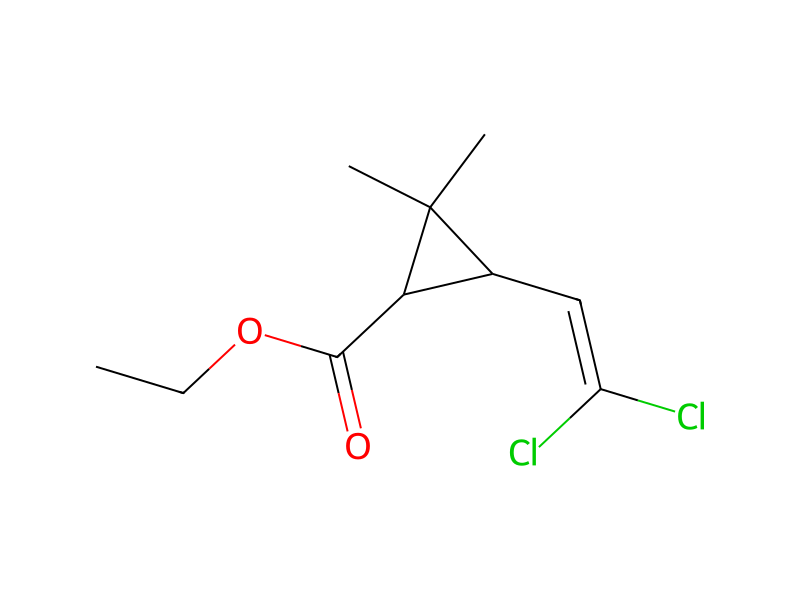
Ethyl 4,6,6-trichloro-3,3-dimethyl-5-hexenoate → Cyclopropanecarboxylic acid, 3-(2,2-dichloroethenyl)-2,2-dimethyl-, ethyl ester
Reaction equation

[Na].[CH3:2][C:3]([CH3:16])([CH:10](Cl)[CH:11]=[C:12]([Cl:14])[Cl:13])[CH2:4][C:5]([O:7][CH2:8][CH3:9])=[O:6]>C(O)C.C(OCC)C.Cl>[CH3:2][C:3]1([CH3:16])[CH:10]([CH:11]=[C:12]([Cl:14])[Cl:13])[CH:4]1[C:5]([O:7][CH2:8][CH3:9])=[O:6]Participants
Reactant 2


Product 1
Reagents, catalysts & solvents 3



Procedure
0.4 Part of metallic sodium was dissolved in 20 parts of anhydrous ethanol, and 2.7 parts of ethyl 3,3-dimethyl-4,6,6-trichloro-5-hexenoate was added to the solution. The mixture was agitated for 2 hours under reflux of ethanol. The liquid reaction mixture was diluted with about 50 parts of diethyl ether and neutralized with dried hydrogen chloride gas. The precipitated crystal of sodium chloride was removed by filtration and low-boiling-point substances were removed from the filtrate by distillation. The residue was then subjected to distillation under reduced pressure to obtain 2.1 parts of ethyl 2,2-dimethyl-3-(2',2'-dichlorovinyl)-cyclopropane-carboxylate having a boiling point of 72° - 73° C. under 0.3 mm Hg. The yield was 87%. The properties of the product were in agreement with those of ethyl 2,2-dimethyl-3-(2',2'-dichlorovinyl)-cyclopropane-carboxylate described in Example 1.
Workup
- additionwas added to the solution
- customThe liquid reaction mixture
- customThe precipitated crystal of sodium chloride was removed by filtration and low-boiling-point substances
- customwere removed from the filtrate by distillation
- distillationThe residue was then subjected to distillation under reduced pressure
Sources & evidence
- ORD record
- ord-0fba9ff473604fd9982b0a8cb54d44dd
- Source dataset
- uspto-grants-1978_09
- Patent number
- US04113968
Reaction notes
Loading…