Methanol → HCID 178513077, compound
Reaction equation

CO.C[O-].[Na+].Cl.[NH2:7][C:8]([NH2:10])=[NH:9].Cl.Cl[C:13]([C:15]1[C:23]2[C:18](=[N:19][CH:20]=[CH:21][CH:22]=2)[N:17]([C:24]2[CH:29]=[CH:28][N:27]=[CH:26][CH:25]=2)[CH:16]=1)=[O:14]>O1CCCC1.ClCCl>[N:27]1[CH:28]=[CH:29][C:24]([N:17]2[C:18]3=[N:19][CH:20]=[CH:21][CH:22]=[C:23]3[C:15]([C:13]([NH:9][C:8]([NH2:10])=[NH:7])=[O:14])=[CH:16]2)=[CH:25][CH:26]=1Participants






Conditions
- Temperature
- 20 °C
Procedure
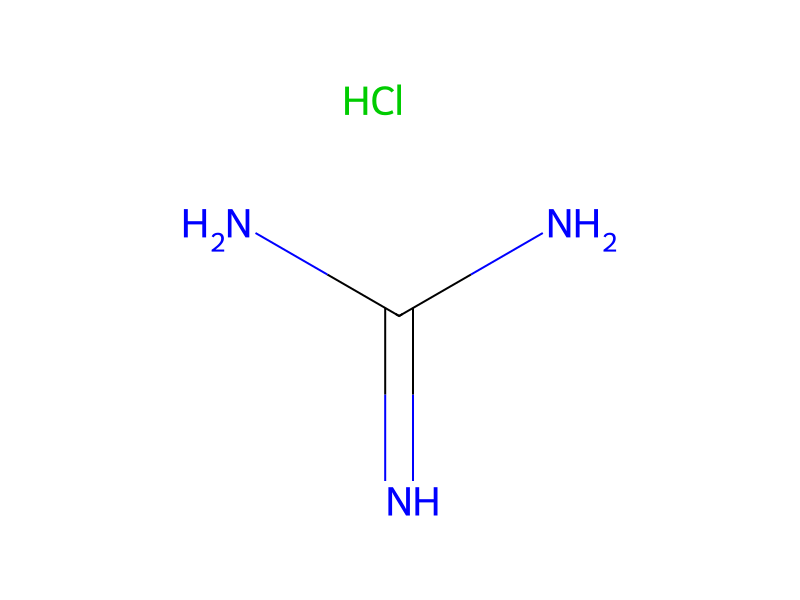
20 cm3 of methanol and then a solution of 70 cm3 of 0.5M sodium methoxide were added, at a temperature in the region of 20° C. under an argon atmosphere, to 3.34 g (35 mmol) of guanidine hydrochloride and the reaction mixture was stirred at a temperature in the region of 20° C. for 1 h. The reaction mixture was subsequently concentrated to dryness under reduced pressure (2.7 kPa) and the residue was 3 times in succession taken up in 20 cm3 of dichloromethane (stabilized over amylene) and concentrated to dryness under reduced pressure (2.7 kPa). The residue obtained was taken up in 50 cm3 of tetrahydrofuran under an argon atmosphere at a temperature in the region of 20° C. and 1.8 g (7 mmol) of 3-chlorocarbonyl-1-(pyridin-4-yl)-1H-pyrrolo[2,3-b]pyridine hydrochloride, in suspension in 50 cm3 of dichloromethane, were added with stirring, followed by 50 cm3 of tetrahydrofuran and 50 cm3 of dichloromethane. After stirring at a temperature in the region of 20° C. for 15 h, the reaction mixture was concentrated to dryness under reduced pressure (2.7 kPa). The residue was taken up in 50 cm3 of ethanol and the mixture was heated at reflux for 5 minutes and then reconcentrated to dryness under reduced pressure (2.7 kPa). The residue was purified by flash chromatography on a column of silica gel (0.04–0.06 mm), elution being carried out with an ethyl acetate/methanol/aqueous ammonia (80/20/5 by volume) mixture. The fractions comprising the expected product were combined and concentrated to dryness under reduced pressure (2.7 kPa). The residue was taken up in 30 cm3 of water and the solution was basified with 1N sodium hydroxide and then 50 cm3 of ethyl acetate were added. After filtration, the organic phase was separated by settling, dried over magnesium sulfate and then concentrated to dryness under reduced pressure (2.7 kPa). The residue was triturated in 20 cm3 of diisopropyl ether, filtered and dried under reduced pressure (2.7 kPa) at a temperature in the region of 40° C. 45 mg of N-[1-(pyridin-4-yl)-1H-pyrrolo[2,3-b]pyridine-3-carbonyl]guanidine were thus obtained in the form of a white powder melting at 210° C. Mass spectrum: EI: m/z=280 M+ base peak.
Workup
- concentrationThe reaction mixture was subsequently concentrated to dryness under reduced pressure (2.7 kPa)
- concentrationconcentrated to dryness under reduced pressure (2.7 kPa)
- customThe residue obtained
- additionwere added
- stirringwith stirring
- stirringAfter stirring at a temperature in the region of 20° C. for 15 h
- concentrationthe reaction mixture was concentrated to dryness under reduced pressure (2.7 kPa)
- temperaturethe mixture was heated
- temperatureat reflux for 5 minutes
- customThe residue was purified by flash chromatography on a column of silica gel (0.04–0.06 mm), elution
- concentrationconcentrated to dryness under reduced pressure (2.7 kPa)
- addition50 cm3 of ethyl acetate were added
- filtrationAfter filtration
- customthe organic phase was separated
- dry with materialdried over magnesium sulfate
- concentrationconcentrated to dryness under reduced pressure (2.7 kPa)
- customThe residue was triturated in 20 cm3 of diisopropyl ether
- filtrationfiltered
- customdried under reduced pressure (2.7 kPa) at a temperature in the region of 40° C
Sources & evidence
- ORD record
- ord-db219ab38de94296ab958a2e4baabfa9
- Source dataset
- uspto-grants-2007_06
- Patent number
- US07230007B2
Reaction notes
Loading…