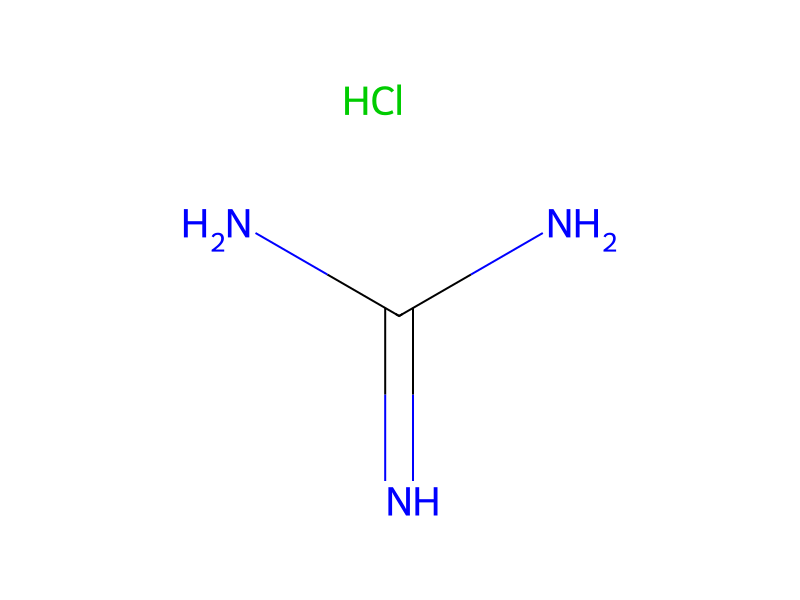
Guanidine Hydrochloride → HCID 178513079, compound
Reaction equation

[Na].Cl.[NH2:3][C:4]([NH2:6])=[NH:5].Cl.Cl[C:9]([C:11]1[C:19]2[C:14](=[N:15][CH:16]=[CH:17][CH:18]=2)[N:13]([C:20]2[C:29]3[C:24](=[CH:25][CH:26]=[CH:27][CH:28]=3)[CH:23]=[CH:22][N:21]=2)[CH:12]=1)=[O:10]>CO>[C:20]1([N:13]2[C:14]3=[N:15][CH:16]=[CH:17][CH:18]=[C:19]3[C:11]([C:9]([NH:5][C:4]([NH2:6])=[NH:3])=[O:10])=[CH:12]2)[C:29]2[C:24](=[CH:25][CH:26]=[CH:27][CH:28]=2)[CH:23]=[CH:22][N:21]=1Participants
Reactant 3


Product 1

Reagents, catalysts & solvents 1

Procedure
0.397 g (17.28 mmol) of sodium (washed beforehand in toluene) was gradually added to 40 cm3 of methanol at a temperature in the region of 20° C. under an argon atmosphere. After dissolving with stirring, 1.685 g (17.28 mmol) of guanidine hydrochloride were added and the mixture was stirred at a temperature in the region of 20° C. for 1 h 30. The reaction mixture was filtered and then concentrated to dryness under reduced pressure (2.7 kPa). The residue was subsequently taken up in a mixture of 70 cm3 of tetrahydrofuran and 70 cm3 of dichloromethane under an argon atmosphere at a temperature in the region of 20° C. and then 3.46 mmol of 3-chlorocarbonyl-1-(isoquinolin-1-yl)-1H-pyrrolo[2,3-b]pyridine hydrochloride were added thereto with stirring. After stirring at a temperature in the region of 20° C. for 15 h, the reaction mixture was concentrated to dryness under reduced pressure (2.7 kPa). The solid residue was taken up in 100 cm3 of water and stirred for 2 h, and then the insoluble material was filtered off. The solid was dried and then triturated in 20 cm3 of cyclohexane. The solid was filtered off and then dried at a temperature in the region of 20° C. under reduced pressure (2.7 kPa) and 0.784 g of N-[1-(isoquinolin-1-yl)-1H-pyrrolo[2,3-b]pyridine-3-carbonyl]guanidine was thus obtained in the form of a light yellow solid melting at 250° C. 1H N.M.R. spectrum (300 MHz, (CD3)2SO, δ in ppm): 7.31 (dd, J=8 and 5 Hz, 1H), 7.58 (broad d, J=8.5 Hz, 1H), 7.66 (ddd, J=8.5, 7.5 and 1 Hz, 1H), 7.89 (ddd, J=8.5, 7.5 and 1 Hz, 1H), 8.09 (d, J=5.5 Hz, 1H), from 8.10 to 8.25 (mt, 2H), 8.29 (s, 1H), 8.56 (d, J=5.5 Hz, 1H), 8.90 (dd, J=8 and 1.5 Hz, 1H).
Workup
- dissolutionAfter dissolving
- stirringthe mixture was stirred at a temperature in the region of 20° C. for 1 h 30
- filtrationThe reaction mixture was filtered
- concentrationconcentrated to dryness under reduced pressure (2.7 kPa)
- additionThe residue was subsequently taken up in a mixture of 70 cm3 of tetrahydrofuran and 70 cm3 of dichloromethane under an argon atmosphere at a temperature in the region of 20° C.
- stirringwith stirring
- stirringAfter stirring at a temperature in the region of 20° C. for 15 h
- concentrationthe reaction mixture was concentrated to dryness under reduced pressure (2.7 kPa)
- stirringstirred for 2 h
- filtrationthe insoluble material was filtered off
- customThe solid was dried
- customtriturated in 20 cm3 of cyclohexane
- filtrationThe solid was filtered off
- dry with materialdried at a temperature in the region of 20° C. under reduced pressure (2.7 kPa) and 0.784 g of N-[1-(isoquinolin-1-yl)-1H-pyrrolo[2,3-b]pyridine-3-carbonyl]guanidine
Sources & evidence
- ORD record
- ord-5af6a42d6b6c45b9b8c42b30808cbc65
- Source dataset
- uspto-grants-2007_06
- Patent number
- US07230007B2
Reaction notes
Loading…