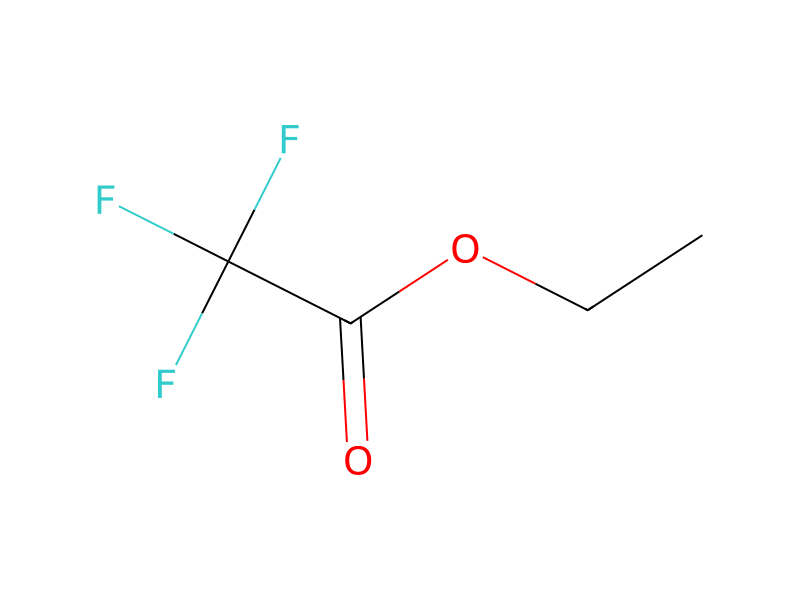
Ethyl trifluoroacetate → HCID 17967065, compound
Reaction equation

[H-].[Na+].[CH3:3][S:4][C:5]1[CH:6]=[CH:7][C:8]([C:11](=[O:13])[CH3:12])=[N:9][CH:10]=1.[F:14][C:15]([F:22])([F:21])[C:16](OCC)=[O:17]>O1CCCC1>[F:14][C:15]([F:22])([F:21])[C:16](=[O:17])[CH2:12][C:11]([C:8]1[CH:7]=[CH:6][C:5]([S:4][CH3:3])=[CH:10][N:9]=1)=[O:13]Participants
Reactant 3


Product 1

Reagents, catalysts & solvents 1

Procedure
A stirring solution of sodium hydride (0.253 g, 6.31 mmol) in anhydrous tetrahydrofuran (20 mL) was cooled under nitrogen to 0° C. before the addition of 1-(5-methylsulfanyl-pyridin-2-yl)-ethanone (0.880 g, 5.26 mmol) in anhydrous tetrahydrofuran (20 mL). Ethyl trifluoroacetate (0.751 mL, 6.31 mmol) was added dropwise and the reaction allowed to rise in temperature to 22° C., then heated to reflux and stirred under nitrogen for 17 hours. The solvent was removed and the residue partitioned between saturated aqueous ammonium chloride (10 mL) and dichloromethane (10 mL). The aqueous layer was separated and extracted with DCM (×3). The organic layers were combined, dried and the solvent removed to yield the title compound: MS m/z 264 (M+1).
Workup
- customto rise in temperature to 22° C.
- temperatureheated
- temperatureto reflux
- customThe solvent was removed
- customthe residue partitioned between saturated aqueous ammonium chloride (10 mL) and dichloromethane (10 mL)
- customThe aqueous layer was separated
- extractionextracted with DCM (×3)
- customdried
- customthe solvent removed
Sources & evidence
- ORD record
- ord-4778132dfcb84a13844ce6b9088f24dc
- Source dataset
- uspto-grants-2007_06
- Patent number
- US07235560B2
Reaction notes
Loading…