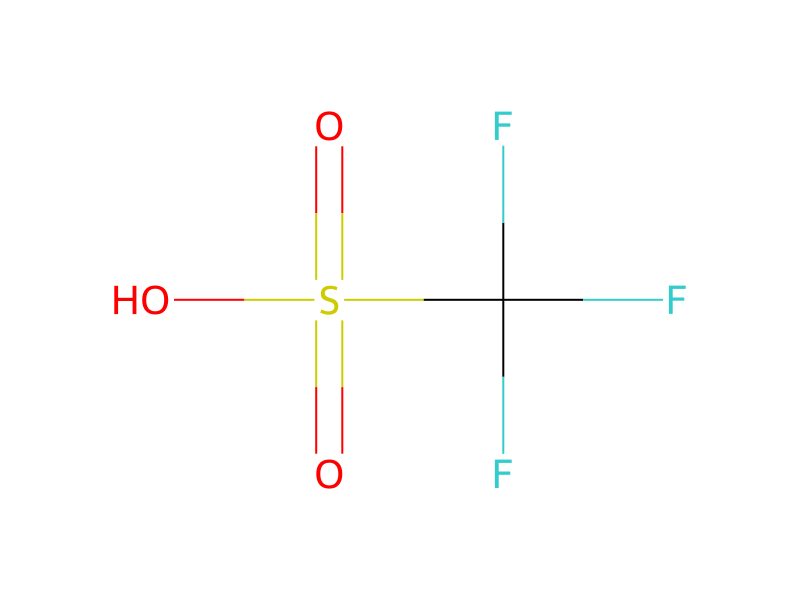
Trifluoromethanesulfonic acid → HCID 21114627, compound
Reaction equation

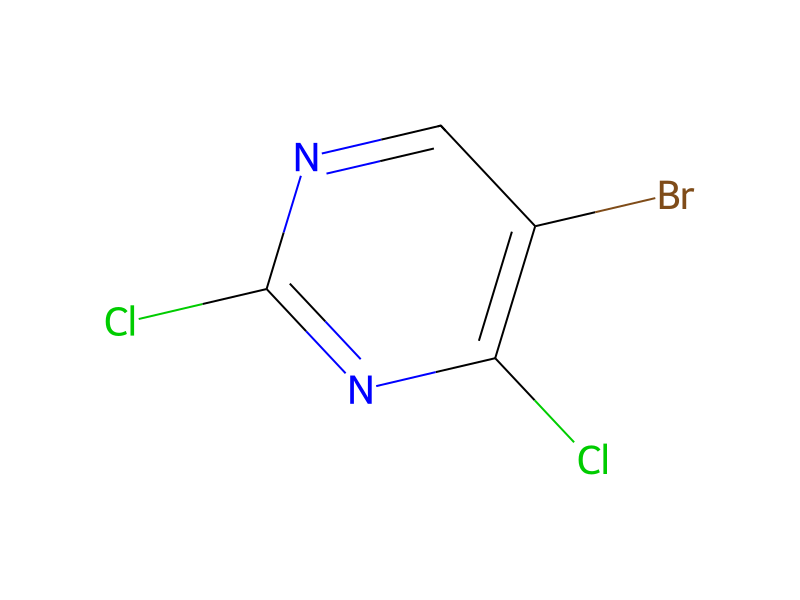
[Br:1][C:2]1[C:3](Cl)=[N:4][C:5](Cl)=[N:6][CH:7]=1.[F:10][C:11]([F:17])([F:16])[CH2:12][CH2:13][CH2:14][OH:15].[F:18][C:19]([F:25])([F:24])S(O)(=O)=O>O>[Br:1][C:2]1[C:3]([O:15][CH2:14][CH2:13][CH2:12][C:19]([F:25])([F:24])[F:18])=[N:4][C:5]([O:15][CH2:14][CH2:13][CH2:12][C:11]([F:17])([F:16])[F:10])=[N:6][CH:7]=1Participants
Reactant 3

Product 1

Reagents, catalysts & solvents 1

Procedure
3.19 g (14 mmol) of 5-bromo-2,4-dichloropyrimidine is mixed with 8.06 g (63 mmol) of 4,4,4-trifluorobutanol, and 0.74 ml (8.4 mmol) of trifluoromethanesulfonic acid is slowly added to it. The reaction mixture is stirred overnight at room temperature and then poured into water. The mixture is extracted by means of ethyl acetate, the combined organic phases are dried on MgSO2, and the solvent is evaporated by means of underpressure. The product is always contaminated with varying amounts of 2,4-bisalkoxypyrimidine. The remaining material is therefore purified by means of gradient chromatography with silica gel as a carrier medium (eluant: hexane and hexane/ethyl acetate at a 9:1 ratio). This process results in a yield of 1.70 g (38%) and also yields 1.93 g (34%) of 5-bromo-2,4-bis-(4,4,4-trifluorobutoxy)pyrimidine (starting compound).
Workup
- additionis slowly added to it
- extractionThe mixture is extracted by means of ethyl acetate
- customthe combined organic phases are dried on MgSO2
- customthe solvent is evaporated by means of underpressure
- customThe remaining material is therefore purified by means of gradient chromatography with silica gel as a carrier medium (eluant
Sources & evidence
- ORD record
- ord-b98a5425e7f24ce7bdd7c18e9605f07c
- Source dataset
- uspto-grants-2007_06
- Patent number
- US07235561B2
Reaction notes
Loading…