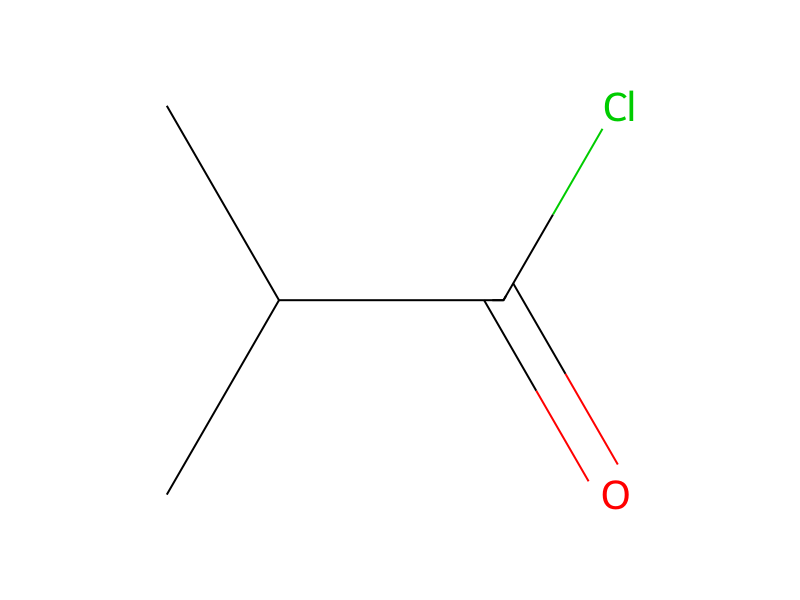
Isobutyryl chloride → HCID 10475320, compound
Reaction equation

[C:1](Cl)(=[O:5])[CH:2]([CH3:4])[CH3:3].[NH2:7][C:8]1[CH:17]=[CH:16][CH:15]=[C:14]2[C:9]=1[CH:10]=[CH:11][CH:12]=[C:13]2[S:18]([NH:21][C:22]1[O:26][N:25]=[C:24]([CH3:27])[C:23]=1[CH3:28])(=[O:20])=[O:19].C(=O)([O-])O.[Na+]>N1C=CC=CC=1.CC(C)=O>[CH3:27][C:24]1[C:23]([CH3:28])=[C:22]([NH:21][S:18]([C:13]2[CH:12]=[CH:11][CH:10]=[C:9]3[C:14]=2[CH:15]=[CH:16][CH:17]=[C:8]3[NH:7][C:1](=[O:5])[CH:2]([CH3:4])[CH3:3])(=[O:20])=[O:19])[O:26][N:25]=1Participants
6
Reactant 3


Product 1

Reagents, catalysts & solvents 2


Procedure
Isobutyryl chloride (0.144 mL, 1.38 mmol) was added dropwise to a solution of Example 3 (0.350 g, 1.10 mmol) in pyridine (1 mL) and acetone (7 mL). The mixture was stirred for 2.5 hours and the acetone was removed under vacuum to leave a thick brown residue, which was added dropwise to half-saturated sodium hydrogen carbonate (30 mL). The pH of the resulting mixture was adjusted to 8-8.5 with saturated sodium hydrogen carbonate. The crude product was precipitated by acidifying the solution to pH 1.5 with 6N hydrochloric acid, filtered and dried. Recrystallization from methanol/water afforded 51% of a solid.
Workup
- customthe acetone was removed under vacuum
- customto leave a thick brown residue, which
- customThe crude product was precipitated
- filtrationfiltered
- customdried
- customRecrystallization from methanol/water
Sources & evidence
- ORD record
- ord-36857430f83846c7b305a664a92f6b88
- Source dataset
- uspto-grants-1995_01
- Patent number
- US05378715
Reaction notes
Loading…