Allyl chloride → 4,4-Dichloro-2-phenyl-4-silaheptane
Reaction equation

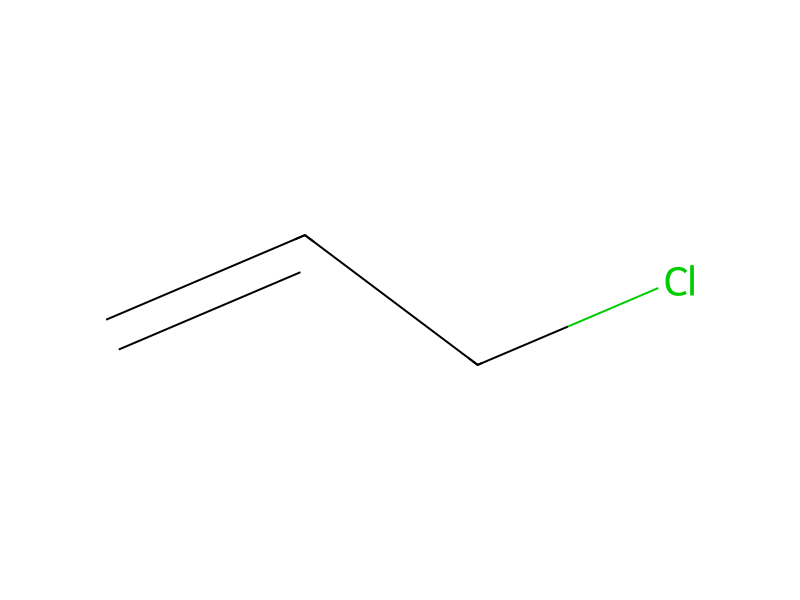
C1(C(C)C[SiH](Cl)Cl)C=CC=CC=1.C(Cl)C=C.[SiH4].Cl[CH2:19][CH2:20][CH2:21][Si:22]([Cl:33])([Cl:32])[CH2:23][CH:24]([C:26]1[CH:31]=[CH:30][CH:29]=[CH:28][CH:27]=1)[CH3:25].C1(C(C)C[Si](Cl)(Cl)Cl)C=CC=CC=1>[H+].[H+].Cl[Pt-2](Cl)(Cl)(Cl)(Cl)Cl>[Cl:32][Si:22]([Cl:33])([CH2:21][CH2:20][CH3:19])[CH2:23][CH:24]([C:26]1[CH:31]=[CH:30][CH:29]=[CH:28][CH:27]=1)[CH3:25]Participants
Reactant 5


Product 1

Reagents, catalysts & solvents 1

Procedure
To a 500 ml, three neck, round bottomed flask equipped with a mechanical stirrer, a dropping funnel, and a reflux condenser, 6.0 g (0.03 mole) of 3-phenyl-1,1-dichloro-1-silabutane, 6.28 g (0.09 mole) of allyl chloride, and 150 μl of 1% chloroplatinic acid in isopnopanol were placed under the dry nitrogen atmosphere. The flask was then immersed in a hot water bath of 45°-50° C. The solution was stirred vigorously for three hours. Gas chromatography analysis showed that no silane was Left. Vacuum distillation of the solution gave 2.21. g (bp, 111°-2° C./0.6 mmHg) of 1,4,4-trichloro-6-phenyl-4-silaheptane and 2.63 g of 3-phenyl-1,1,1-trichloro-1-silabutane. Besides these products, a small amount of 4,4-dichloro-2-phenyl-4-silaheptane was also obtained.
Workup
- customTo a 500 ml, three neck, round bottomed flask equipped with a mechanical stirrer, a dropping funnel, and a reflux condenser
- customThe flask was then immersed in a hot water bath of 45°-50° C
- waitwas Left
- distillationVacuum distillation of the solution
- customgave 2.21
Sources & evidence
- ORD record
- ord-05421f19eae94c13807805b87ab69b7f
- Source dataset
- uspto-grants-1995_01
- Patent number
- US05386050
Reaction notes
Loading…