Diisopropylethylamine → tert-butyl N-[2-[(5-bromo-2-chloro-pyrimidin-4-yl)amino]ethyl]carbamate
Reaction equation

[Br:1][C:2]1[C:3](Cl)=[N:4][C:5]([Cl:8])=[N:6][CH:7]=1.CCN(C(C)C)C(C)C.[C:19]([O:23][C:24]([NH:26][CH2:27][CH2:28][NH2:29])=[O:25])([CH3:22])([CH3:21])[CH3:20]>C(O)C>[Br:1][C:2]1[C:3]([NH:29][CH2:28][CH2:27][NH:26][C:24](=[O:25])[O:23][C:19]([CH3:21])([CH3:20])[CH3:22])=[N:4][C:5]([Cl:8])=[N:6][CH:7]=1Participants
5


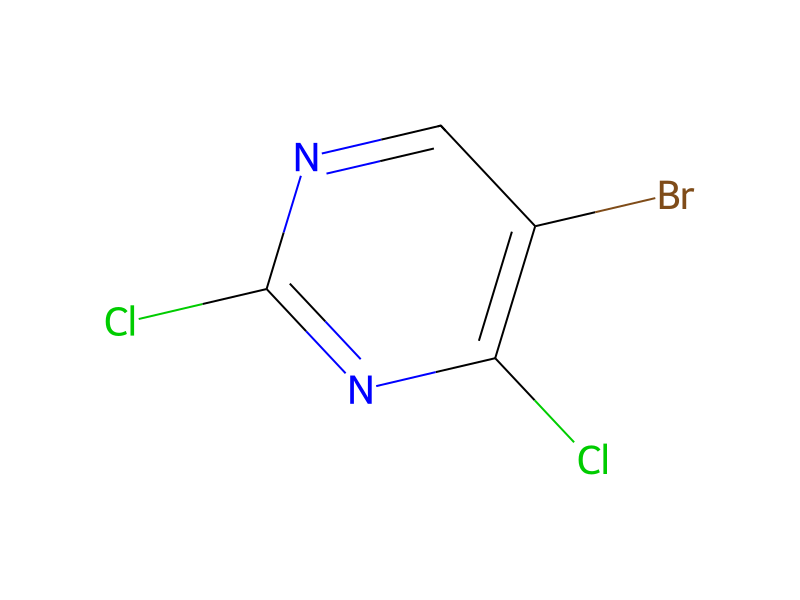


Procedure
To a solution of 5-bromo-2,4-dichloropyrimidine 12.80 g (0.054 mole) in ethanol 250 mL was added Hunig's base 12.0 mL followed by the addition of a solution of N-(tert-butoxycarbonyl)-1,2-diaminoethane 10 g (0.0624 mole) in 80 mL ethanol. The contents were stirred overnight for 20 hrs. The solvent was evaporated under vacuum. Ethyl acetate (800 mL) and water (300 mL) was added and the layers separated. The organic layer was dried with magnesium sulfate and then concentrated under vacuum. Column chromatography on silica gel using hexane/ethyl acetate (0-60%) afforded tert-butyl N-[2-[(5-bromo-2-chloro-pyrimidin-4-yl)amino]ethyl]carbamate. LCMS (ESI) 351 (M+H).
Workup
- customThe solvent was evaporated under vacuum
- additionEthyl acetate (800 mL) and water (300 mL) was added
- customthe layers separated
- dry with materialThe organic layer was dried with magnesium sulfate
- concentrationconcentrated under vacuum
Sources & evidence
- ORD record
- ord-5f61cf2c4d6347198bfd066a461a3001
- Source dataset
- uspto-grants-2016_02
- Patent number
- US09260442B2
Reaction notes
Loading…