(+)-Lactose → (2R,3S,4R,5R)-2,3,4,5,6-pentahydroxyhexanal
Reaction equation

[OH:1][CH:2]1[O:21][C@H:20]([CH2:22][OH:23])[C@@H:7]([O:8][C@@H]2O[C@H](CO)[C@H](O)[C@H](O)[C@H]2O)[C@H:5]([OH:6])[C@H:3]1[OH:4].O=C[C@@H]([C@H]([C@H]([C@@H](CO)O)O)O)O>O>[O:1]=[CH:2][C@@H:3]([C@H:5]([C@@H:7]([C@@H:20]([CH2:22][OH:23])[OH:21])[OH:8])[OH:6])[OH:4]Participants
Reactant 2

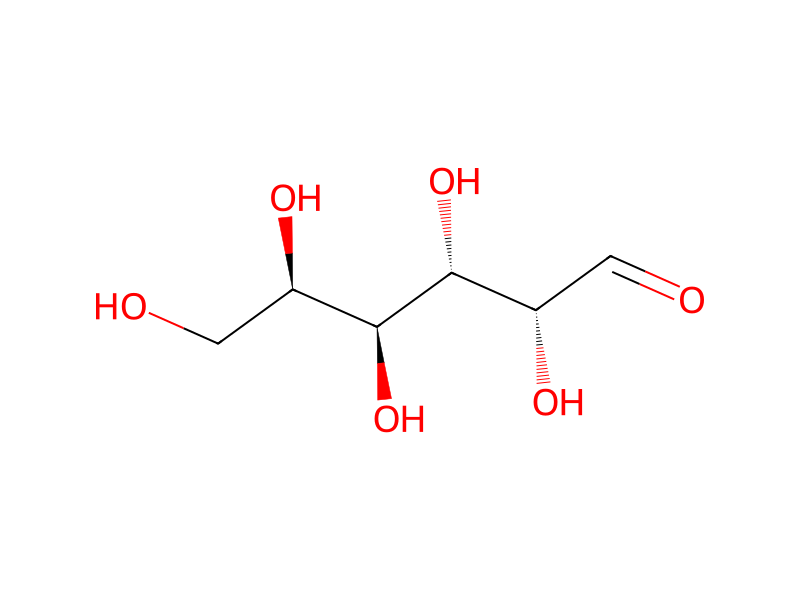
Product 1

Reagents, catalysts & solvents 1

Procedure
The hydrolysis of lactose requires the incorporation of equal moles of water and lactose to yield one mole each of glucose and galactose. Neutral lactase enzyme (2600-4000 units per liter (MaxiLact)) is injected into the milk concentrate to hydrolyze the lactose sugar into glucose and galactose. Preferably, a minimum of 70% of the lactose must be hydrolyzed and the desired level is in the 98% range. This process reduces water activity by decreasing the amount of water and by increasing the number of moles of sugar dissolved in the concentrate. Since lactose solubility is about 21.6%, a 4× concentration of milk is the practical limit of concentration using conventional technology. Further concentration results in graininess, crystallization and viscosity increases. Furthermore, the insoluble lactose must be subtracted from the water activity equation since it is no longer dissolved.
Sources & evidence
- ORD record
- ord-2faf7236e5dc4f14b34fcb6eaa844dd5
- Source dataset
- uspto-grants-2016_02
- Patent number
- US09265269B2
Reaction notes
Loading…