Sulfuric Acid → Sulfite
Reaction equation

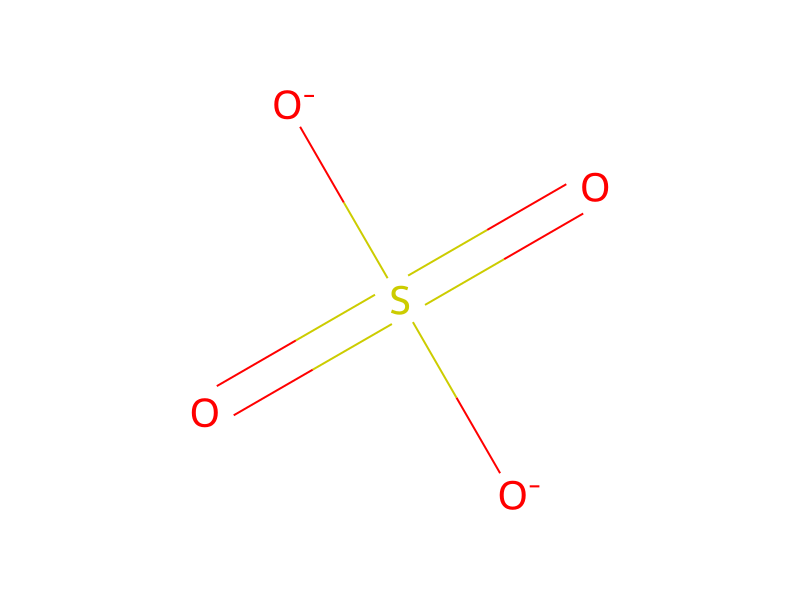
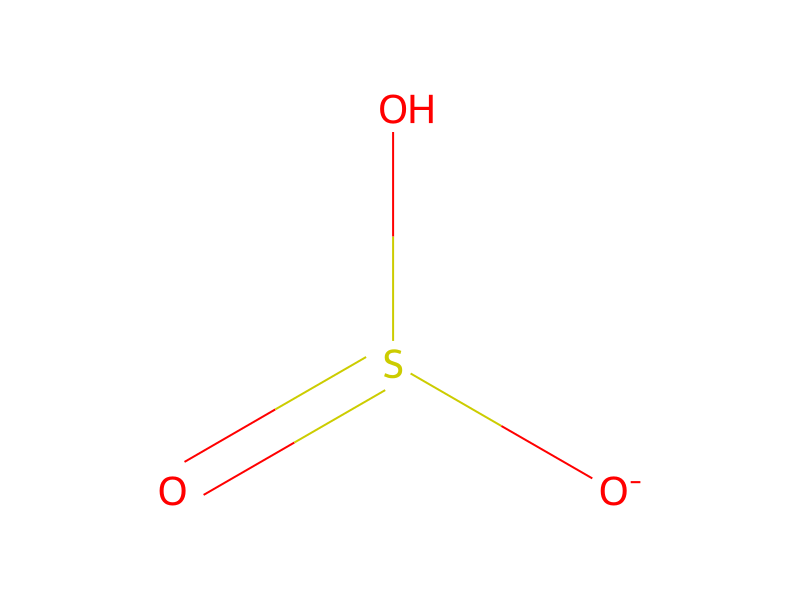
[Ca].[S:2](=[O:6])(=[O:5])([OH:4])[OH:3]>CCOCC>[S:2]([O-:6])([O-:5])(=[O:4])=[O:3].[S:2](=[O:4])(=[O:3])([OH:6])[O-:5].[S:2]([O-:5])([O-:4])=[O:3].[S:2](=[O:3])([OH:5])[O-:4]Participants
Reactant 2


Product 4


Reagents, catalysts & solvents 1

Procedure
The preferred calcium-containing catalysts are those which have previously been employed for alkoxylation processes. For example, Smith et al., WO 2006/025898, which is incorporated by reference, generally describes an alkoxylation catalyst comprising a calcium-containing compound modified by the addition of a acid, preferably a strong acid, generally referred to herein as “Catalyst Z”. Carboxylic acids or ether components are optionally added to the catalyst composition. More specifically, in one aspect of the invention, Catalyst Z is formed by a method comprising the steps of: a) combining an alkaline-earth compound (preferably a compound of calcium) with a carboxylic acid to form a first mixture; b) adding a strong mineral acid, such as sulfuric acid, to said first mixture to form a second mixture; and c) mixing the second mixture to a uniform appearance. Additionally, optional materials such as solvents, carriers, fluidizers, etc. may be present at any stage of the process for producing the catalyst. Polyalkylene glycols and polyoxyalkylated alcohols, including alkyl-end-capped glycol ethers, are preferable, including those sold by Huntsman, LLC of Houston Tex. under the tradename POGOL®MP-116 glycol ether. In another aspect of the invention. Catalyst Z is formed by a method comprising the steps of: a) combining an alkaline-earth compound (preferably a compound of calcium) with one or more additional materials selected from the group consisting of: a carboxylic acid, a polyalkylene glycol having a molecular weight between about 100 and 1000, an C1-C10 alkyl-capped polyalkylene glycol having molecular weight between about 100 and 1000, and mixtures including any of the foregoing, to form a first mixture; b) combining said first mixture with at least one ionic chemical species selected from the group consisting of: sulfuric acid, an organic sulfonic acid, an organic sulfonate, a sulfate, a bisulfate, a sulfite, a bisulfite, any C1-C12 carboxylic acid, or any C1-C12 carboxylate so as to form a second mixture; and c) mixing said second mixture to a uniform appearance, to provide a finished catalyst. Leach, U.S. Pat. No. 4,775,653 and Sandoval et al., U.S. Pat. No. 5,220,077, which are both incorporated by reference, generally describe an alkoxylation catalyst comprising a calcium-containing compound, an alkoxylated alcohol as a dispersing medium, an inorganic acid, and a metal alkoxide, such as aluminum alkoxide or titanium alkoxide (generally referred to herein as “Catalyst A”). Knopf et al., U.S. Pat. Nos. 4,754,075 and 4,820,673, which are incorporated by reference, describe a catalyst comprising a calcium compound provided in a solvent medium (ethylene glycol, propylene glycol, diethylene glycol, glycerol, butanediols, propane diol, and the like) modified by a strong inorganic acid, like sulfuric acid or phosphoric acid (generally referred to herein as “Catalyst B”). Lin et al., U.S. Pat. No. 5,627,121, which is incorporated by reference, describes an alkoxylation catalyst comprising a calcium-containing compound at least partially dispersed in an alkoxylated alcohol mixture, wherein a carboxylic acid is added to produce a calcium composition having titratable alkalinity, and the composition is preferably partially neutralized with an inorganic acid to produce a partially neutralized calcium-containing catalyst (generally referred to herein as “Catalyst C”). Weerasooriya et al., U.S. Pat. No. 7,119,236, which is also incorporated by reference, describes an improved alkoxylation catalyst suitable for alkoxylating compounds. The alkoxylation catalyst comprises a calcium-containing compound in a dispersing medium having a boiling point less than 160° C. with a carboxylic acid and an inorganic acid or anhydride (generally referred herein as “Catalyst D”). Combinations of such catalysts are also contemplated, such as those in Matheson et al., U.S. Patent Pub. No. 2007/0060770, which is incorporated by reference (generally referred to herein as “Catalyst Y”).
Workup
- additioncontaining compound
- additionmodified by the addition of a acid
- customto form a first mixture
- additionb) adding a strong mineral acid
- customto form a second mixture
- additionand c) mixing the second mixture to a uniform appearance
- customfor producing the catalyst
- customto form a first mixture
Sources & evidence
- ORD record
- ord-25f7b1525f1f46ee9f08cebc9aeb2a15
- Source dataset
- uspto-grants-2016_02
- Patent number
- US09266821B2
Reaction notes
Loading…