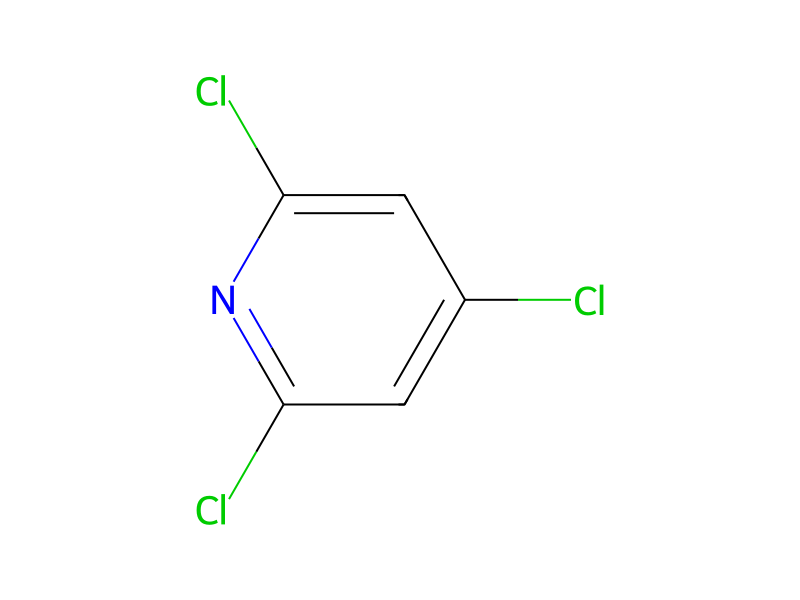
Pyridine, 2,4,6-trichloro- → HCID 117678380, compound
Reaction equation

[Cl:1][C:2]1[CH:7]=[C:6](Cl)[CH:5]=[C:4]([Cl:9])[N:3]=1.[CH:10]1([C:14]#[N:15])[CH2:13][CH2:12][CH2:11]1.C[Si]([N-][Si](C)(C)C)(C)C.[Li+]>C1COCC1>[Cl:1][C:2]1[CH:7]=[C:6]([C:10]2([C:14]#[N:15])[CH2:13][CH2:12][CH2:11]2)[CH:5]=[C:4]([Cl:9])[N:3]=1Participants
5
Reactant 3


Product 1

Reagents, catalysts & solvents 1

Procedure
To a stirring solution of 2,4,6-trichloropyridine (1.00 g, 5.48 mmol) and cyclobutanecarbonitrile (0.53 mL, 5.5 mmol) in anhydrous THF (27 mL) at −78° C. and under nitrogen was added lithium bis(trimethylsilyl)amide (6.0 mL, 6.0 mmol, 1.0 M solution in THF). The cooling bath was removed and stirring continued for 1 h. The reaction was quenched by the addition of sat. aq. NH4Cl, extracted with CH2Cl2 and organics dried over MgSO4. Following concentration, the reaction residue was purified by flash column chromatography (100:0 heptanes/EtOAc 85:15 heptanes/EtOAc) to afford the title compound as a white solid (0.995 g, 76%); 1H NMR (400 MHz, CDCl3) δ 7.34 (s, 2H), 2.92-2.80 (m, 2H), 2.68-2.40 (m, 3H), 2.23-2.08 (m, 1H).
Workup
- customThe cooling bath was removed
- customThe reaction was quenched by the addition of sat. aq. NH4Cl
- extractionextracted with CH2Cl2
- dry with materialorganics dried over MgSO4
- concentrationconcentration
- customthe reaction residue was purified by flash column chromatography (100:0 heptanes/EtOAc 85:15 heptanes/EtOAc)
Sources & evidence
- ORD record
- ord-2711a186652342fbbe2855b4c15eab1d
- Source dataset
- uspto-grants-2016_02
- Patent number
- US09266862B2
Reaction notes
Loading…