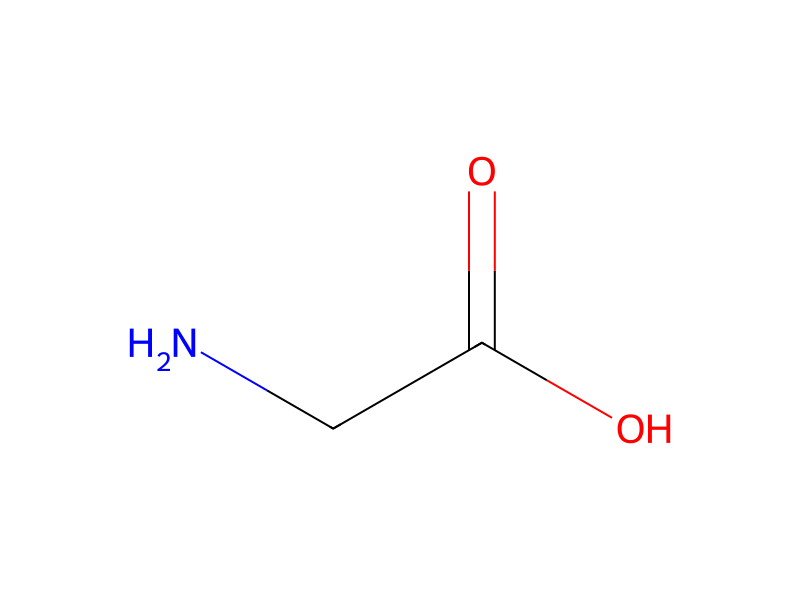
Glycine → HCID 21189956, compound
Reaction equation

[Cl:1][C:2]1[CH:7]=[C:6]([N+:8]([O-:10])=[O:9])[C:5](Cl)=[CH:4][C:3]=1[Br:12].C([O-])(O)=O.[Na+:17].[NH2:18][CH2:19][C:20]([OH:22])=[O:21]>CN(C=O)C.O>[Na+:17].[Br:12][C:3]1[C:2]([Cl:1])=[CH:7][C:6]([N+:8]([O-:10])=[O:9])=[C:5]([NH:18][CH2:19][C:20]([O-:22])=[O:21])[CH:4]=1Participants
Reactant 3


Product 1

Reagents, catalysts & solvents 2


Conditions
- Temperature
- 65 °C
Procedure
To a stirred solution of 2,5-dichloro-4-nitrobromobenzene (1.000 g, 3.691 mmol, as prepared above) in DMF (10.0 mL) at 65° C., was added, dropwise, a solution of NaHCO3 (0.316 g, 3.76 mmol) and glycine (0.280 g, 3.73 mmol, Aldrich, used as received) in water (3.8 mL). The resulting suspension was stirred at 65° C. for 65 h. The bright orange suspension was then cooled to room temperature, filtered, washed with water (1.0 mL), and dried under vacuum to afford 0.284 g (98%, based on recovered starting material) of the pure (1H NMR) title compound as an orange powder; m.p. 264°-265° C. (decomposed); 1H NMR (DMSO-d6): δ3.451 (d, 2H, J=3.9 Hz), 7.199 (s, 1H), 8.130 (s, 1H), 8.793 (t, 1H, J=3.6 Hz). It was used as such for the next reaction.
Workup
- temperatureThe bright orange suspension was then cooled to room temperature
- filtrationfiltered
- washwashed with water (1.0 mL)
- customdried under vacuum
- customto afford
- custom0.284 g (98%, based on recovered starting material) of the pure (1H NMR) title compound as an orange powder
- customsuch for the next reaction
Sources & evidence
- ORD record
- ord-0b069435ba774dba9ff2497ddd53fbd5
- Source dataset
- uspto-grants-1997_05
- Patent number
- US05631373
Reaction notes
Loading…