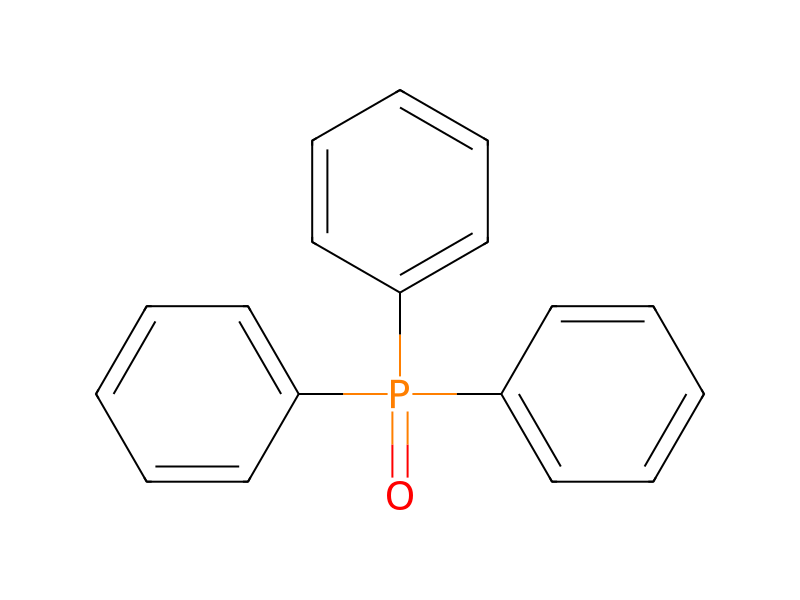
Acetic acid, 2-(triphenylphosphoranylidene)-, methyl ester → Triphenylphosphine Oxide
Reaction equation

C(N1CCC(=O)CC1)(=[O:8])C1C=CC=CC=1.COC(C=[P:21]([C:34]1[CH:39]=[CH:38][CH:37]=[CH:36][CH:35]=1)([C:28]1[CH:33]=[CH:32][CH:31]=[CH:30][CH:29]=1)[C:22]1[CH:27]=[CH:26][CH:25]=[CH:24][CH:23]=1)=O>C1(C)C=CC=CC=1>[C:34]1([P:21](=[O:8])([C:28]2[CH:29]=[CH:30][CH:31]=[CH:32][CH:33]=2)[C:22]2[CH:27]=[CH:26][CH:25]=[CH:24][CH:23]=2)[CH:39]=[CH:38][CH:37]=[CH:36][CH:35]=1Participants
Reactant 2


Product 1
Reagents, catalysts & solvents 1

Procedure
Under N2, a mixture of 1-benzoyl-4-piperidone (10.2 g, 0.05 mol), methyl (triphenylphosphoranylidene) acetate (25 g. 0.074 mol) in toluene (100 ml) was heated at reflux for 7 hours. After stirring at room temperature overnight, the solid was filtered off to yield 13.9 g (100%) of triphenylphosphine oxide. The mother liquor was concentrated to dryness and the residue was treated with acetic acid (42 ml), H2O, (6 ml) and 12 N HCl (6 ml). The mixture was heated at 80°-85° C. with stirring for 15 hours. The reaction was then concentrated to dryness and the residue was partitioned between saturated Na2CO3 and ethyl acetate. The aqueous layer was further extracted with ethyl acetate (1×), neutralized to pH 3 with 6 N HCl and extracted with ethylacetate (4×). The organic layer was dried, filtered and concentrated to dryness to yield 7.2 g (59%) of title compound.
Workup
- temperaturewas heated
- temperatureat reflux for 7 hours
- filtrationthe solid was filtered off
Sources & evidence
- ORD record
- ord-442301e70e88430aba7d194beb8dd46d
- Source dataset
- uspto-grants-1997_05
- Patent number
- US05633247
Reaction notes
Loading…