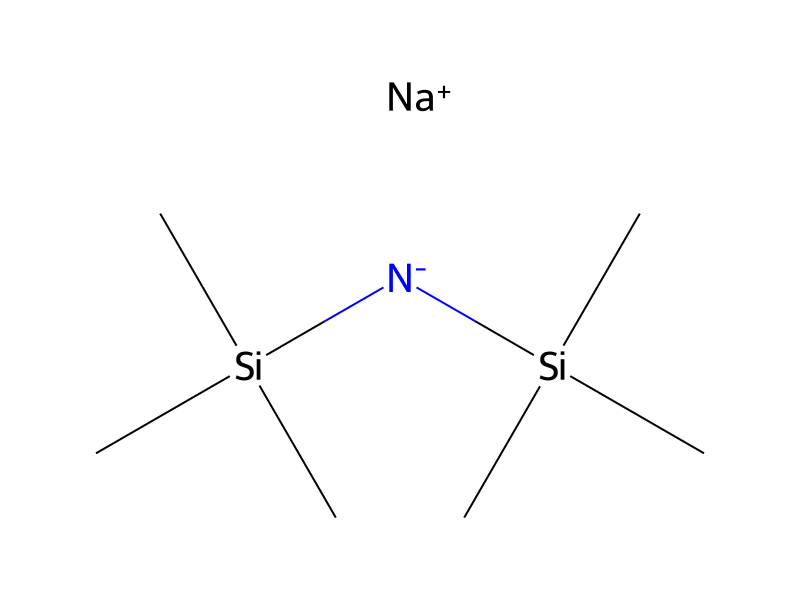
Sodium bis(trimethylsilyl)amide → HCID 54738224, compound
Reaction equation

C[O:2][C:3](=O)[C:4]1[C:5](=[CH:21][C:22]([Cl:25])=[CH:23][CH:24]=1)[NH:6][C:7](=[O:20])[CH2:8][S:9][CH2:10][CH2:11][CH2:12][CH2:13][C:14]1[CH:19]=[CH:18][CH:17]=[CH:16][CH:15]=1.C[Si]([N-][Si](C)(C)C)(C)C.[Na+]>O1CCCC1>[Cl:25][C:22]1[CH:21]=[C:5]2[C:4]([C:3]([OH:2])=[C:8]([S:9][CH2:10][CH2:11][CH2:12][CH2:13][C:14]3[CH:19]=[CH:18][CH:17]=[CH:16][CH:15]=3)[C:7](=[O:20])[NH:6]2)=[CH:24][CH:23]=1Participants
4
Reactant 2

Product 1

Reagents, catalysts & solvents 1

Procedure
6.3 g (16.12 mmol) of 4-chloro-N-(4-phenylbutylthio)acetyl-anthranilic acid methyl ester are placed in 60 ml of tetrahydrofuran at 0°, and 48.3 ml of a 1-molar solution of sodium bis-trimethylsilylamide are added dropwise thereto. The mixture is then stirred for 30 minutes at room temperature. The reaction mixture is poured into 200 ml of 2N hydrochloric acid/ice and the resulting white suspension is filtered with suction and the colourless crystals are dried under a high vacuum at 60°. 7-chloro-3-(4-phenylbutylthio)-4-hydroxy-2(1H)-quinolone is obtained in the form of colourless crystals having a melting point of 176°.
Workup
- filtrationthe resulting white suspension is filtered with suction
- customthe colourless crystals are dried under a high vacuum at 60°
Sources & evidence
- ORD record
- ord-cfcefff489c14c4f9d86aae323fb0601
- Source dataset
- uspto-grants-1997_05
- Patent number
- US05633379
Reaction notes
Loading…